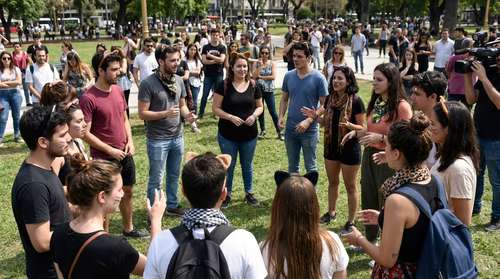
It’s a sunny Sunday afternoon in a bustling Buenos Aires plaza, but the teenagers gathering near the trees aren’t playing soccer or scrolling through phones on park benches. Instead, they are on all fours, leaping over obstacles with feline agility and growling softly at curious passersby. This is the frontline of weird world news 2026, where a rapidly growing subculture known as "therians" is blurring the line between human and beast. In what has become a massive viral animal phenomenon, young Argentines are donning hyper-realistic masks and forming "human packs," claiming they don’t just love animals—they identify as them on a spiritual or psychological level.
The Rise of the "Therian" Movement in Buenos Aires
While the concept of therianthropy (identifying as a non-human animal) has existed in niche internet corners for years, 2026 has seen it explode into the mainstream in Argentina. The identifying as animals trend has moved from TikTok screens to physical public spaces, turning city parks into makeshift wildernesses. Leading the charge is 15-year-old Aguara, a social media influencer with over 125,000 followers who identifies as a Belgian Malinois.
"I wake up like a normal person and live my life like a normal person," Aguara explained to local reporters during a recent meet-up, wearing her signature gear. "I simply have moments when I like being a dog." She leads a "pack" of like-minded teens who coordinate these gatherings online, creating a space where they can express their "theriotypes"—the specific animal species they feel an intrinsic connection to, ranging from foxes and cats to seals and wolves.
Quadrobics: The Sport of Imitating Wildlife
Central to this Argentina animal identity craze is a physical discipline known as "quadrobics." Participants train rigorously to run, jump, and move on four limbs, mimicking the biomechanics of their chosen animal. In viral videos circulating on social media, teens like Sofía, who wears a lifelike beagle mask, can be seen clearing waist-high hurdles and sprinting across the grass with startling speed.
For many participants, quadrobics is more than just exercise; it's a form of somatic therapy that helps them connect with their "phantom limbs"—the sensation of having a tail or ears that aren't physically there. However, not everyone in the park is a spiritual believer. A segment of the community, calling themselves "otherpaws," participates purely for the fun of the roleplay and the athletic challenge, without the deep psychological identification.
From TikTok Virality to Real-World Controversy
The movement's explosion is inextricably linked to social media algorithms. The hashtag #therian has surpassed 2 million posts globally, with Argentina leading Latin America in engagement. This digital visibility has turned a private identity into a bizarre social trend, drawing both fascination and ire from the public. While some onlookers applaud the creativity and community building, others react with confusion or open hostility, viewing the behavior as a disturbing rejection of humanity.
Psychologists Weigh In on the Phenomenon
Is this just funny news today, or a sign of a deeper psychological shift? Experts are urging the public not to panic. Débora Pedace, a prominent psychologist and director of the Integral Therapeutic Center in Buenos Aires, suggests that for the vast majority of these teens, the behavior is a form of symbolic exploration rather than a mental illness.
"From a psychological standpoint, this is a symbolic identification with an animal," Pedace noted in a recent interview. She emphasized that the trend becomes pathological only if a person loses touch with reality or engages in self-harm. For most, the "pack" offers a vital sense of belonging in a post-digital world where traditional social structures have eroded. In a country known for its "fairly free" social environment, these young people are simply testing the boundaries of identity in a radically new way.
A New Kind of Social Community
As funnyvot weird world news stories go, the image of teenagers barking in a park might seem absurd at first glance. Yet, for the participants, the "pack" provides unconditional acceptance that they often struggle to find in schools or traditional peer groups. Whether they are leaping through the air as Belgian Malinois or lounging in trees as foxes, these young Argentines are redefining what it means to be social in 2026.
As the trend continues to grow, it challenges bystanders to question their own definitions of normalcy. For now, the parks of Buenos Aires belong to the packs, and the rest of the world is just watching from the sidelines, wondering what species will emerge next.