In a bizarre and fascinating turn of events that sounds like it was ripped from the script of 2001: A Space Odyssey, a groundbreaking chimpanzee crystal study has revealed that our closest primate relatives possess a deep-seated obsession with shimmering, transparent stones. Published this week in Frontiers in Psychology, the research suggests that the human fascination with crystals—often dismissed as New Age pseudoscience—may actually be an ancient evolutionary trait hardwired into our DNA. Reports from the field indicate that some apes are not just admiring these stones but actively hoarding them, sparking debates about primate spiritual rituals and the origins of aesthetic appreciation.
The 'Monolith' Experiment: Chimps Choose Bling Over Rocks
The study, led by crystallographer Juan Manuel García-Ruiz of the Donostia International Physics Center in Spain, set out to test whether the attraction to symmetrical, shiny objects is unique to humans. In an experiment playfully dubbed "The Monolith"—a nod to the mysterious alien artifact in Stanley Kubrick's classic film—researchers presented a group of enculturated chimpanzees with a choice: a dull sandstone rock or a shimmering quartz crystal.
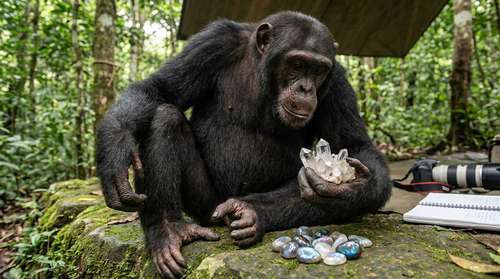
The results were instant and undeniable. The chimps, including individuals named Toti, Yvan, and Sandy, consistently ignored the ordinary rocks and gravitated toward the crystals. But they didn't just play with them; they studied them. "The chimpanzees began to study the crystals' transparency with extreme curiosity, holding them up to eye level and looking through them," García-Ruiz noted. This behavior, described as primate aesthetic behavior, mirrors how a human gemologist might inspect a diamond, suggesting a cognitive appreciation for the object's physical properties rather than its utility.
Hoarding 'Spiritual' Stones: A New Form of Animal Intelligence?
What makes this animal intelligence discovery even more compelling is the value the chimpanzees assigned to these objects. Unlike tools used for cracking nuts or fishing for termites, these crystals served no survival purpose. Yet, the chimps treated them as high-value treasures. In one instance, a female chimp named Sandy was observed carrying multiple crystals in her mouth—a behavior rarely seen unless a chimp is hiding something valuable—and transporting them to a private platform to sort them by transparency and luster.
The obsession was so intense that researchers often had to barter with the primates to get the crystals back. The chimps would only relinquish their "precious" stones in exchange for high-reward treats like bananas and yogurt, confirming that they viewed the chimp shimmering stones as a currency of sorts. This hoarding behavior aligns with weird animal behavior 2026 trends, where researchers are increasingly finding that animals possess complex emotional and aesthetic inner lives previously thought to be exclusive to humans.
From Stone Throwing to Crystal Collecting: Evidence of Ritual?
This new finding provides a missing puzzle piece for explaining other strange behaviors observed in the wild. For years, primatologists have been puzzled by "sacred trees" in West Africa, where wild chimpanzees inexplicably pile stones in hollow trunks or throw rocks at specific trees in what appears to be a ritualistic display. With the revelation that chimps have an innate attraction to specific rock properties, experts now believe these stone piles might be a primitive form of primate spiritual rituals.
The transition from piling rough stones to collecting translucent crystals represents a significant leap in our understanding of the primate mind. If wild populations are indeed beginning to select stones for their beauty rather than just their weight or shape, it suggests we are witnessing the dawn of a proto-culture focused on aesthetics—a "Stone Age" of art and spirituality unfolding in real-time.
Evolutionary Roots of Our Own Obsessions
Why does this matter to us? Because it holds a mirror up to our own history. Archaeological sites dating back 780,000 years are littered with crystals found alongside early human ancestors. These stones weren't used as tools or weapons; they were simply collected. The chimpanzee crystal study implies that the urge to pick up a pretty rock on the beach isn't just a quirk—it's an ancient instinct shared across species.
As this weird world news story develops, researchers plan to expand their observations to wild populations to see if this "gem instinct" drives the selection of sites for their mysterious stone rituals. For now, one thing is clear: the appreciation of beauty is not a uniquely human trait, but a bridge connecting us to our primate cousins in the most shimmering, spiritual way imaginable.