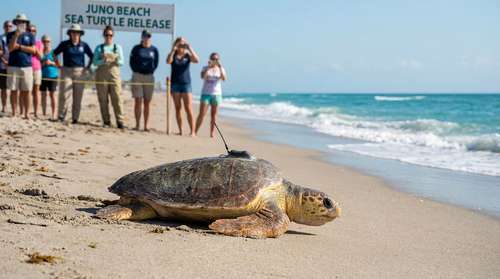
A resilient loggerhead named Pyari sea turtle made a triumphant return to the Florida coast yesterday, captivating onlookers with her unique silhouette. Dubbed a "cyborg" by fascinated social media users, the three-flippered shark attack survivor crawled into the surf at Juno Beach, her shell equipped with a prominent, waving satellite antenna. The release marks a significant milestone for Florida sea turtle rehab efforts and has quickly become one of the most heartwarming viral animal stories of the year.
A Chilly Morning for the 'Cyborg' Release
Despite uncharacteristically chilly temperatures in the 40s, a bundled-up crowd gathered behind the Loggerhead Marinelife Center (LMC) on Wednesday morning to bid farewell to their beloved patient. Pyari, whose name means "lovely" or "beloved" in Hindi, didn't seem to mind the cold air as she made her way toward the warmer 77-degree waters of the Atlantic.
Spectators cheered as the loggerhead trundled across the sand, the long antenna of her satellite tracker turtle device swaying rhythmically with each push. This high-tech addition is what gives her the futuristic "cyborg" appearance that is making waves in weird animal news 2026. While the antenna looks unusual, it serves a critical scientific purpose, allowing researchers to monitor her progress in real-time.
Surviving the Shark Attack: Pyari's Journey
Pyari's road to recovery began in November 2025, when she was rescued by the Inwater Research Group in St. Lucie County. She arrived at the rehabilitation center in critical condition, bearing the gruesome signs of a predator attack—likely a shark. The encounter left her with severe injuries to her neck and shell, and catastrophic damage to her left front flipper.
Veterinary teams had no choice but to amputate most of the damaged limb, leaving Pyari as a three-flippered turtle. For many marine animals, such an injury could be a death sentence, but sea turtles are notoriously resilient. Under the care of LMC's staff, she healed remarkably fast, learning to swim and dive with her remaining flippers. Her successful rehabilitation highlights the advanced capabilities of modern Florida sea turtle rehab centers.
The Science Behind the Satellite Tag
The device strapped to Pyari's carapace is more than just a viral curiosity; it is a $10,000 scientific instrument designed to answer a crucial question: How well do amputee turtles survive in the wild? Dr. Heather Barron, the center's chief science officer, emphasized that while the release is emotional, the data gathering has just begun.
"It's particularly gratifying when you can track them on satellite and see exactly where they're going and what they're doing," Barron told reporters. By following Pyari's movements, scientists hope to learn if three-flippered turtles can migrate and forage as effectively as their four-flippered counterparts. This data is vital for making future decisions about rehabilitating and releasing injured turtles.
A Viral Sensation with a Mission
The image of Pyari, with her "cybernetic" antenna silhouetted against the morning sun, has captured the public's imagination. In an era where weird animal news 2026 often focuses on the bizarre, Pyari's story offers a narrative of hope and technological integration for conservation.
She is not alone in her mission; the Loggerhead Marinelife Center is currently tracking two other amputee turtles to build a comprehensive dataset. As Pyari disappeared into the waves of the Juno Beach turtle release site, she carried with her not just a satellite tag, but the hopes of conservationists who believe that even with three flippers, she can thrive in the open ocean.
How to Track Pyari
For those inspired by this Pyari sea turtle story, the journey isn't over. The public can follow her migration online through the conservation center's tracking portal. As she navigates the Atlantic, every ping from her antenna provides proof of life and resilience, turning a single survivor's story into a beacon for marine conservation worldwide.