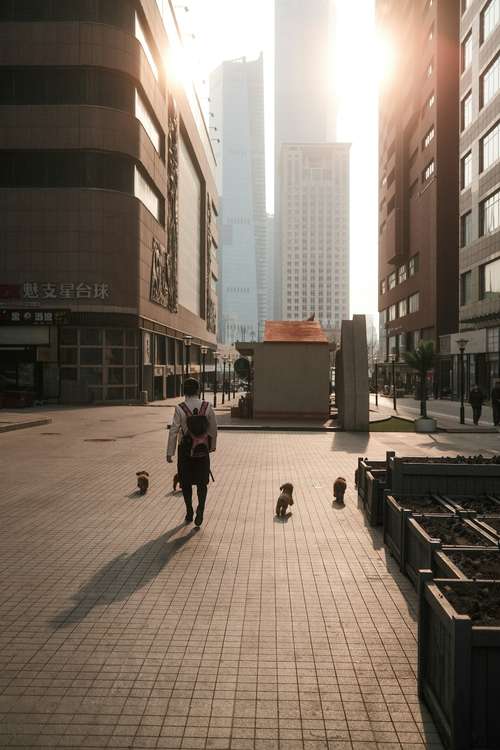
If you thought the Bay Area had already reached peak tech eccentricity, you might want to recalibrate your expectations. In what is rapidly becoming the most talked-about piece of San Francisco weird news this year, locals in the SoMa district and around Oracle Park have been confronted by a truly surreal spectacle. A highly advanced mechanical hound, sporting an eerily hyper-realistic silicone mask of the Tesla and SpaceX CEO, has been casually strolling down sidewalks, waving at confused tourists, and even barking at local pets. This Elon Musk robot dog has taken the internet by storm, blending futuristic robotics with a distinctly dystopian artistic vision.
The Artist Behind the Bizarre Street Sightings
The footage of the cybernetic canine has spread like wildfire across social media platforms, cementing its status as the ultimate viral robot video 2026. But this isn't a glitch in the matrix, an AI hallucination, or a rogue experiment escaped from a Silicon Valley laboratory. When it comes to bizarre street sightings, a robot wearing a billionaire's face certainly tops the list. The mastermind behind this unsettling creation is none other than Mike Winkelmann, the renowned digital artist known globally as Beeple. Winkelmann made history in 2021 when he sold a digital artwork at Christie's for a staggering $69.3 million, and his latest project proves he is still pushing the boundaries of contemporary art.
More Than Just One Billionaire
The Elon Musk face robot is the focal point of a new interactive installation titled Regular Animals. The street activation was deployed to promote Beeple's mid-career survey exhibition, INFINITE_LOOP, which opened on April 18 at NODE, a premier digital arts center in Palo Alto. Musk isn't the only public figure getting the robotic treatment. Beeple's collection features a full pack of quadrupedal machines wearing the faces of Meta CEO Mark Zuckerberg, Amazon founder Jeff Bezos, and legendary artists Andy Warhol and Pablo Picasso. The hardware foundation for these creations is the Unitree Go2 robotic dog, while the incredibly lifelike masks are the work of professional special effects designer Landon Meier, widely known as Hyperflesh. The combination results in a mechanical dog San Francisco pedestrians simply cannot ignore.
Uncanny Valley Technology That Poops AI Art
Perhaps the most fascinating aspect of this uncanny valley technology is what the robot does while it wanders. It doesn't just walk in a straight line; it exhibits surprisingly lifelike canine behaviors. Witnesses have watched it squat, lift a leg to say hello, and playfully interact with very confused real-life dogs on their evening walks. In one particularly poetic standoff, the mechanical hound found itself face-to-face with a Waymo autonomous vehicle—a surreal meeting of two distinct visions of an automated future.
But its most controversial feature is its creative output. The robot is equipped with onboard computer vision that constantly maps its surroundings and captures photographs of the people and places it encounters. Using this continuous stream of data, the robot processes the imagery through an algorithm and physically excretes Polaroid-style prints of AI-generated art. For the Elon Musk dog, these prints are rendered in a stark, black-and-white aesthetic inspired by his edgy X platform branding. Meanwhile, the Picasso dog produces cubist designs, and the Zuckerberg version drops Metaverse-styled imagery.
The Deeper Message: Algorithms and Reality
Why subject the public to such an absurd spectacle? According to Beeple, the project is a poignant commentary on modern influence and how tech billionaires have replaced traditional artists as the primary architects of our reality. It used to be that we saw the world interpreted through the eyes of artists, Beeple explained, noting that figures like Musk and Zuckerberg now dictate how we consume information through powerful algorithms that shape politics, art, and truth.
Furthermore, this art piece comes with a built-in lifespan. Each robot is programmed to live for exactly three years—or 21 dog years. Throughout its operational life, all of the robot's interactions, generated artworks, and mapped memories are minted and securely stored on the blockchain. This technological integration ensures that even after the physical machine inevitably breaks down, the digital footprint of this bizarre performance will be immortalized forever. Whether you view it as brilliant satire or terrifying tech-dystopia, the roaming robotic pack has successfully achieved its ultimate goal: it has stopped people in their tracks and forced them to talk about the intersection of art, technology, and concentrated power.