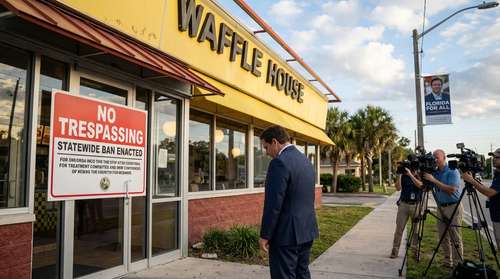
In what social media is already crowning the most uniquely "Florida" political maneuver of all time, a prominent Republican contender has been handed the ultimate Southern exile. James Fishback, a 2026 Florida governor candidate, announced that his campaign has been officially banned from every single Waffle House location across the Sunshine State. His campaign was hit with a statewide Waffle House criminal trespass warning, instantly cementing the ordeal as one of the most bizarre Florida Man stories 2026 has to offer.
To understand the sheer magnitude of a Waffle House ban, you have to understand the cultural significance of the restaurant in the American South. This is not just a place to grab a quick bite; it is a neutral community ground where people from all walks of life gather. It is an institution so resilient that emergency management agencies monitor closures to determine the severity of natural disasters. Being told you are no longer welcome at any of the hundreds of locations across the state carries a unique cultural sting.
Losing access to the iconic 24-hour diner's legendary late-night hash browns is a severe blow for any resident. However, for a politician actively trying to court working-class voters over a cup of black coffee, it is a distinctly hilarious disaster. The story rapidly evolved into viral Florida news, sparking endless jokes across the internet about what it actually takes to get kicked out of an establishment famous for remaining open through Category 5 hurricanes.
From Tucker Carlson to a Waffle House Criminal Trespass
The breakfast-themed saga began in January when Fishback appeared on The Tucker Carlson Show with an unconventional campaign strategy. He boldly announced a statewide Waffle House tour, explaining his intention to visit every single location in Florida to meet voters where they naturally gather. At first, it seemed like a stroke of grassroots genius. Diners represent the pulse of the community, and Fishback publicly claimed he had secured explicit permission from corporate leadership to execute his grand vision.
For a few weeks, the campaign seemed to run smoothly on syrup and sheer political optimism. Fishback managed to make early campaign stops at restaurants in Madison, St. Petersburg, Bonifay, Marianna, and Jacksonville. He shook hands with locals and posed for photos over plates of scattered, smothered, and covered hash browns. The honeymoon phase, however, came to a screeching halt in early March.
The Reality of Mixing Politics with Late-Night Hash Browns
Without warning, the diner chain brought the hammer down. Fishback released a frustrated statement on social media declaring that corporate had abruptly revoked their permission and issued a Waffle House criminal trespass order for all Florida locations. He expressed profound disappointment, noting the chain had allegedly given his team the green light just three weeks prior.
The Social Media Backlash
While the candidate lamented the loss of his preferred campaign venues, internet commentators and local news viewers were quick to point out the logistical nightmare of hosting a political rally inside a compact diner. The situation quickly became prime material for funny local news segments. As one widely shared comment from a local news viewer aptly noted, it is almost like a restaurant does not want loud rallies in their limited space preventing paying customers from finding seats. The idea of navigating a crowded restaurant at 8:00 a.m. only to find a politician blocking the waffle irons struck a chord with everyday patrons.
A Campaign Plagued by Florida Political Scandal
This diner debacle is just the latest hurdle for a campaign that has consistently struggled to find its footing. Fishback is currently trailing significantly in the GOP primary polls, lagging well behind frontrunners like Trump-endorsed Congressman Byron Donalds. The Waffle House ban adds a surreal, distinctly Southern layer to a run already dogged by other controversies.
Political analysts have watched the campaign stumble through various negative headlines, firmly categorizing the entire effort under the umbrella of a developing Florida political scandal. When a candidate makes more news for getting banned from a beloved breakfast institution than for their actual policy proposals, campaign managers typically hit the panic button. Yet, the candidate appears determined to keep the controversy alive, leaning into the notoriety rather than backing away.
Will "Fishback Waffle Home" Save the Campaign?
Determined not to let a corporate ban ruin his grassroots outreach, the candidate has reportedly floated a bizarre pivot. According to recent reports, he intends to launch a pop-up restaurant called "Fishback Waffle Home" in select cities to continue his voter outreach. The strategy attempts to recreate the authentic diner magic without the threat of law enforcement showing up to enforce a trespass order.
Whether Florida voters will trade their authentic pecan waffles for a political imitation remains to be seen. For now, the candidate will have to find somewhere else to get his late-night breakfast fix. In the fiercely competitive landscape of Florida politics, losing the Waffle House vote might just be the most unforgivable misstep of all.