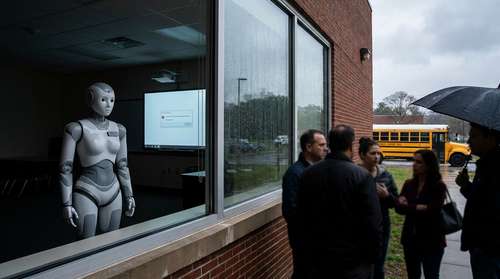

For the past few years, the pitch has been practically irresistible: let artificial intelligence handle the heavy lifting while you sit back and enjoy the reclaimed time. But if you have recently found yourself staring at a screen, juggling four different generative tools, and feeling like your head is filled with white noise, you are not alone. A groundbreaking report published this week in the Harvard Business Review has officially put a name to this thoroughly modern exhaustion: AI brain fry.
According to researchers from Boston Consulting Group (BCG) and the University of California, Riverside, the rapid integration of automation into daily workflows is taking a massive toll on human cognition. Instead of simply easing our burdens, the technology is pushing employees past their natural limits. The resulting mental crash is so severe that it is reshaping how experts view productivity in the digital age.
What Exactly Is 'AI Brain Fry'?
The term isn't just a catchy piece of corporate slang; it describes a very real, documented condition. In a survey of nearly 1,500 full-time workers in the US, about 14 percent reported experiencing intense mental fatigue directly tied to juggling automated tools. The researchers defined AI brain fry as the exhaustion that results from the excessive use, interaction, and oversight of AI beyond a person's natural cognitive capacity.
The mental fatigue symptoms are surprisingly uniform across different industries. Workers described a literal "buzzing" sensation in their heads or a pervasive mental static. One senior engineering manager interviewed for the study perfectly captured the sentiment, noting that their thinking wasn't broken, but rather "filled with noise". Other common complaints include severe difficulty focusing, chronic headaches, and slower decision-making abilities.
Interestingly, this phenomenon disproportionately impacts marketing, software development, human resources, finance, and IT roles. It also targets the people you might least expect: the office superstars. Julie Bedard, a partner at BCG and co-author of the study, noted that the research was initially sparked precisely because they saw these symptoms appearing in highly perceived high performers.
The Productivity Paradox: Why High Performers Are Cooking
To understand why this happens, you have to look at the mechanics of modern workflows. The Harvard AI study 2026 highlights a fascinating productivity paradox. When employees use artificial intelligence to offload simple, repetitive tasks, their stress levels predictably drop. However, the corporate world rarely stops at simple offloading.
Instead, businesses are incentivizing workers to oversee complex networks of multi-agent systems. A single employee might have one tool writing code, another generating marketing copy, and a third summarizing a meeting. Keeping up with the superhuman output speed of these machines creates a massive degree of cognitive overload AI was never supposed to cause.
The human brain simply wasn't built to supervise multiple fast-moving streams of data simultaneously. It requires constant context switching and an exhausting level of hyper-vigilance to catch hallucinations or errors. As workers transition from being "problem solvers" to "tool managers," the AI oversight stress compounds until the system—meaning the human—eventually crashes.
The Hidden Costs of AI Workplace Burnout
If executives think they can ignore this buzzing sensation as a temporary growing pain, the financial data suggests otherwise. AI workplace burnout is actively damaging the bottom line of multibillion-dollar firms.
The BCG and UC Riverside study paints a bleak picture of what happens when cognitive limits are breached. Employees suffering from this specific type of tech-induced exhaustion demonstrated a 39 percent increase in major workplace errors. Furthermore, they experienced a 33 percent spike in decision fatigue, leading to organizational paralysis where critical choices are either delayed or handled poorly.
Perhaps most alarming for HR departments is the impact on retention. The intent to leave a job rose by nearly 10 percent among those who reported feeling fried by their tech stack. When high performers are reduced to exhausted overseers, they don't just complain—they start looking for the exit.
How to Clear the Brain Fog From Technology
The solution isn't to unplug the servers and go back to typewriters. Rather, the researchers emphasize that the core issue lies in how work is designed, not necessarily the technology itself. Tacking automated systems onto yesterday's workflows is a recipe for disaster.
To clear the brain fog from technology, organizations must actively redesign jobs with human cognitive limits in mind. This means moving away from metrics that reward sheer volume or "token consumption" and instead focusing on sustainable interaction. Managers need to set clear boundaries on how many different agents a single employee is expected to monitor at any given time.
We are currently standing at a crossroads in workplace culture. Artificial intelligence has the power to extend our capabilities in incredible ways, but as this latest research proves, the human mind remains the ultimate bottleneck. If we don't start treating our cognitive resources with the same respect we give our tech stacks, the workforce of the future won't be supercharged—it will just be fried.