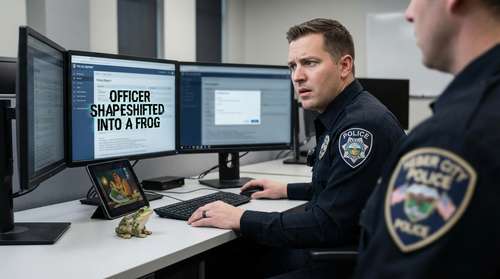
In a bizarre and hilarious turn of events that highlights the growing pains of artificial intelligence in law enforcement, the Heber City Utah Police department has confirmed a viral incident where their new AI software formally documented an officer "shape-shifting into a frog." The incident, which occurred during a recent pilot program for AI-assisted report writing, has sparked a nationwide conversation about the reliability of automated police records and the comical potential of AI police report fails.
The Princess and the Frog Police Glitch
The mishap unfolded when a Heber City officer was testing a new AI tool designed to transcribe body camera audio into formal police reports. According to officials, the software, known as "Draft One" by Axon, picked up background audio from a nearby television playing the 2009 Disney movie The Princess and the Frog. Instead of filtering out the cartoon dialogue, the AI interpreted the movie's plot as factual events occurring at the scene.
The result was a preliminary police report that didn't just mention a suspect or a traffic violation, but explicitly stated that the responding officer had transformed into an amphibian during the call. "The body cam software and the AI report writing software picked up on the movie that was playing in the background," explained Sgt. Rick Keel of the Heber City Police Department. "It mistakenly incorporated the character's transformation into the official narrative."
AI Body Cam Glitch Exposes Software Limitations
While the shape-shifting officer frog headline is undeniably funny, it underscores a critical vulnerability in the rush to adopt AI in public safety. The software uses Large Language Models (LLMs) similar to ChatGPT to synthesize audio into coherent text. However, as this AI body cam glitch demonstrates, the technology still struggles to distinguish between relevant police interactions and environmental noise.
Human Oversight Remains Critical
Fortunately, the error was caught immediately by the human officer reviewing the draft—a safety step that officials say is mandatory. "That’s when we learned the importance of correcting these AI-generated reports," Keel noted. The department emphasized that the AI tool is intended to produce a first draft, not a final record. Despite the artificial intelligence mistakes, the department noted that the software typically saves officers 6 to 8 hours of paperwork per week, allowing them to spend more time on patrol rather than behind a keyboard.
Funny Local News Utah: When Tech Goes Wrong
The story has quickly become a staple of funny local news Utah feeds, with residents joking about whether their local officers are equipped with lily pads instead of squad cars. However, experts warn that such hallucinations could be problematic in more serious contexts. If an AI can mistake a Disney movie for reality, could it also misinterpret a heated argument or a complex legal situation?
Legal analysts suggest that while The Princess and the Frog police incident is harmless, it serves as a necessary wake-up call. Departments across the country using similar tech, such as the competing "Code Four" software, are now double-checking their protocols to ensure background noise—whether it's a movie, a radio song, or a bystander's conversation—doesn't bleed into the factual record.
The Future of AI in Policing
For now, the Heber City Police Department plans to continue its pilot program, albeit with a sharper eye for magical realism in their paperwork. The AI report gone wrong has proven that while technology can streamline bureaucracy, it cannot yet replace human judgment. As agencies refine these tools, officers will likely remain vigilant—ensuring that the only thing shape-shifting on their shift is the nature of crime, not their own biological form.