An Indiana elementary school district has found itself at the center of a national firestorm this week after reports surfaced of School Resource Officers (SROs) issuing formal-looking "tickets" to students caught using the viral "6-7" catchphrase. As the 6-7 slang meaning continues to baffle adults well into 2026, the Tippecanoe County Sheriff’s Office's unique approach to curbing the classroom disruption has sparked a debate about discipline, humor, and absurd school rules. What started as a local attempt to quell a rowdy trend has exploded into weird world news 2026, leaving parents asking: Is this community policing or an overstep?
The "6-7" Phenomenon: What Does It Even Mean?
To understand why police are involved, one must first decode the trend itself. The 6-7 slang meaning has been a moving target since it first emerged, often accompanied by a specific hand gesture resembling weighing scales. Originating from the track "Doot Doot (6 7)" by rapper Skrilla and popularized by memes surrounding NBA star LaMelo Ball’s 6'7" height, the phrase has evolved into a nonsensical "brainrot" term used by Gen Alpha to confuse older generations.
Unlike traditional slang with clear definitions, "6-7" often serves as a disruptor—a loud, non-sequitur shouted in quiet hallways or during lessons. It signifies membership in the youth "in-group" precisely because it is meaningless to teachers. As the trend persists in 2026, schools are finding that standard detentions aren't enough to stop the chorus of numbers.
To Ticket or Not to Ticket: Indiana's Controversial Strategy
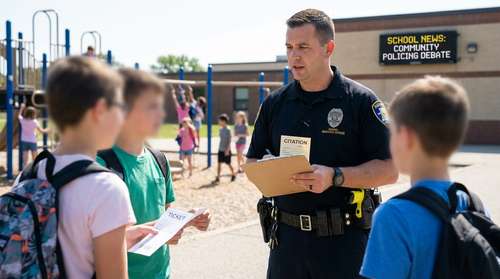
The controversy centers on a strategy deployed in Tippecanoe County, where SROs began issuing "citations" to elementary students. While the Sheriff's Office has clarified that these are "fake tickets" intended as a humorous community-building exercise to "keep parents sane," the imagery of uniformed officers handing citations to young children has triggered a backlash. Indiana school tickets for slang have become a trending topic on social media, with critics arguing that involving law enforcement in minor behavioral trends sets a concerning precedent.
Video footage circulating on TikTok shows officers entering classrooms to "enforce" a mock ordinance banning the phrase. For some, it's a lighthearted prank; for others, it's a dystopian example of school resource officer citations being used for harmless childhood play. "It’s a joke without a punchline for the kids who get scared," commented one concerned parent on a viral thread discussing the incident.
Decoding the Outrage: Viral Slang Trends vs. Discipline
The incident highlights the growing friction between viral slang trends and educational environments. As digital trends move faster than school policies can adapt, educators are resorting to increasingly creative—and sometimes bizarre—methods to maintain order. The "6-7" crackdown is just the latest in a series of weird world news 2026 stories where internet culture collides with real-world institutions.
Supporters of the move argue that the disruption is real. "Imagine trying to teach math when 30 kids scream 'six-seven' every time you say the number 5," noted a local teacher online. From this perspective, the "tickets" are a clever way to engage students on their own level, turning a disciplinary issue into a memorable interaction with local police.
The Skrilla and LaMelo Connection
The staying power of the 6-7 catchphrase is largely fueled by its ambiguity. Whether referencing Skrilla's repetitive lyrics or LaMelo Ball's stature, the term has morphed into a "shibboleth"—a password that proves you are young and online. By attempting to ban it via "tickets," Indiana officials may have inadvertently given the slang a new lease on life, proving the old internet adage: if you try to stop the meme, you become the meme.
A Warning for Other Schools?
As the story continues to circulate this week, other school districts are watching closely. The line between "fun engagement" and "intimidation" is thinner than ever. While the Indiana school tickets were devoid of legal weight, the viral reaction suggests that absurd school rules will be scrutinized heavily by a global audience. For now, students in Tippecanoe might think twice before shouting numbers—but the internet is already waiting for the next trend to take its place.