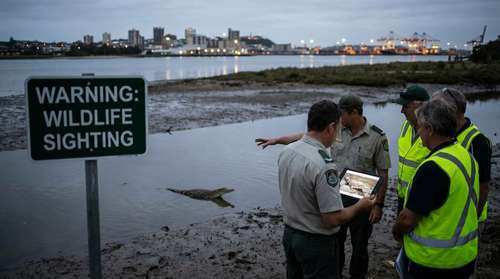
It sounds like the plot of a surreal movie or a viral deepfake: a tropical predator lurking in a quiet suburban creek, over 1,200 miles from its natural home. Yet, for residents of Wallsend in Newcastle, Australia, the impossible became a snapping reality this weekend. On Saturday, February 28, a group of teenagers stumbled upon a juvenile freshwater crocodile cruising the waters of Ironbark Creek—a discovery so outlandish that it was initially dismissed by parents and onlookers as a floating log, a prank, or an AI-generated hoax. The confirmed capture of the reptile late Sunday night has since sparked a nationwide conversation about illegal wildlife trade and the bizarre adaptability of nature.
The 'Glitch in the Matrix' Discovery at Ironbark Creek
The saga began around midday Saturday at Federal Park, a popular community spot behind a Bunnings Warehouse in Wallsend. When a local teenager called his mother, Stephanie Kirsop, to report a crocodile in the creek, her reaction was one of immediate skepticism—a sentiment shared by many in an era of digital misinformation.
"This is a trick… it looks like a crocodile but that's probably a log," Kirsop recalled thinking. In 2026, where AI-generated images of animals in bizarre places flood social media feeds daily, her doubt was natural. It took two hours of persuasion for her to visit the site, where the undeniable reality stared back at her: a live reptile, nearly a meter long, swimming casually in the temperate waters of New South Wales.
Once the shock wore off, the authorities were alerted. NSW Police officers arrived at the scene around 4:30 PM, confirming the sighting and establishing a perimeter to keep curious onlookers safe from the unexpected visitor.
The High-Stakes Rescue Mission
Capturing a cryptic predator in murky water is no simple task. The Australian Reptile Park, renowned for their expertise with dangerous wildlife, was called in to lead the operation. Head of Reptiles Billy Collett spearheaded the rescue, which quickly turned into a multi-day game of cat-and-mouse.
Initial attempts on Saturday night, assisted by the State Emergency Service (SES) and a rescue raft, proved unsuccessful. The elusive reptile slipped away into the dark, muddy depths of the creek. "We didn't have a boat [on Saturday], so the SES dropped us off a rescue raft," Collett explained. "We paddled that down but it was just too slow."
The 'Swan Dive' Capture
The team returned on Sunday night, March 1, equipped with a motorized tinny, head torches, and renewed determination. After an hour of searching with no sightings, hope began to fade. However, near the Hunter Wetlands—approximately three kilometers downstream from the original sighting—the gleam of eyeshine betrayed the crocodile's position.
In a move Collett described as a "swan dive," he launched himself from the boat to secure the animal underwater. "I got under her, grabbed her, and secured her," he said, confirming the safe capture of the sub-adult female freshwater crocodile. The successful rescue brought a collective sigh of relief to the Wallsend community.
A 1,200-Mile Biological Mystery
The most baffling aspect of this Newcastle crocodile discovery is the sheer geography involved. Freshwater crocodiles (Crocodylus johnstoni) are native to the tropical northern regions of Australia—Queensland, the Northern Territory, and Western Australia. Newcastle, a temperate coastal city, lies roughly 2,500 kilometers (over 1,500 miles) south of their natural range.
Wildlife experts have unequivocally ruled out a natural migration. The "trek" is impossible for a cold-blooded reptile of this species, which relies on tropical heat to survive. "They're native to the top end of Australia," Collett noted, emphasizing that the animal would not have survived the upcoming colder winter conditions in NSW.
The consensus among experts is that this "mysterious trek" was actually a car ride. The animal is believed to be an illegal pet that was dumped in the creek when it became too large or difficult to manage. "People get these pets because that is going to be so cool, but once a croc is a metre long… it's a pretty big animal," explained Alex Martinovich, the park's marketing manager.
Status and Safety
Following its capture, the crocodile was transported to the Australian Reptile Park on the NSW Central Coast for a full veterinary assessment. Preliminary checks suggest the animal, believed to be a female around 10 years old, is in reasonable health despite her ordeal.
While freshwater crocodiles are generally considered less dangerous to humans than their larger saltwater cousins, a bite from a frightened animal can still cause significant injury. The incident serves as a stark reminder of the unpredictability of modern urban ecosystems and the irresponsible nature of the illegal exotic pet trade.