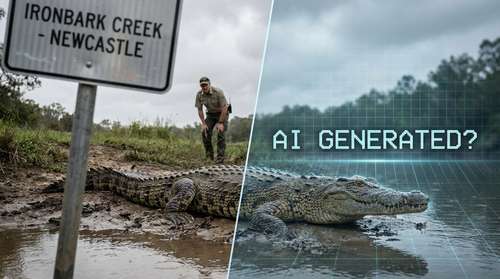
In a bizarre twist that has blurred the lines between digital fabrication and biological reality, a freshwater crocodile has been discovered in a suburban creek near Newcastle, Australia—a staggering 1,200 miles south of its native habitat. The sightings, which began circulating on social media earlier this week, initially sparked a fierce Newcastle crocodile discovery debate, with many dismissing the footage as a high-quality AI hoax. However, local wildlife officials have since confirmed the impossible: the reptile is real, alive, and very far from home.
The "Impossible" Ironbark Creek Sighting
The saga began on Saturday when 12-year-old Lionel Saunders and a group of friends spotted a meter-long reptile basking in Ironbark Creek, a popular fishing spot in the Newcastle suburb of Wallsend. When Lionel video-called his mother, Stephanie Kirsop, to show her the creature, her reaction mirrored the skepticism of the internet at large.
"I told him it was a log," Kirsop admitted in an interview with local press. "He rang me back and said, 'Mom, I'm serious.' I drove down there thinking I was going to be the butt of a joke, but sure enough, there was a little crocodile swimming around."
When Kirsop sent photos to the Australian Reptile Park, even the experts were hesitant. Park manager Billy Collett confessed that his first instinct was to flag the images as deepfakes. "These days with AI, it's just so crazy," Collett said. "We get so many prank calls, and the idea of a tropical freshwater croc surviving in the temperate waters of Newcastle seemed scientifically impossible."
AI vs. Reality: Why Skepticism Went Viral
The incident has become a textbook example of weird world news 2026, highlighting a growing modern dilemma: the difficulty of verifying reality in an era of hyper-realistic generative AI. Within hours of the first upload, the footage of the Ironbark Creek sighting was dissected by online sleuths claiming the water physics looked "rendered" and the texture of the scales appeared "generated."
The debate highlights a valid point regarding AI vs reality animal photos. As generative models become more sophisticated, the threshold for believing extraordinary wildlife sightings has risen significantly. For many, a 1200 mile crocodile journey seemed less plausible than a teenager using a new video generation tool. It wasn't until NSW Police and National Parks and Wildlife Service (NPWS) officers physically secured the perimeter that the online speculation shifted from "fake" to "how?"
The High-Stakes Midnight Rescue
Once the Australian wildlife mystery was confirmed as flesh and blood, a rescue operation was launched. The freshwater crocodile (Crocodylus johnstoni) is native to the tropical northern regions of Australia—Queensland, the Northern Territory, and Western Australia. Ironbark Creek, located roughly 100 miles north of Sydney, offers a climate far too cold for the species to survive the approaching winter.
The Capture
Billy Collett and his team from the Australian Reptile Park led the capture effort. After an initial failed attempt on Saturday, they returned Sunday night with a boat and thermal equipment. In a dramatic conclusion to the strange reptile migration story, Collett spotted the crocodile's eyeshine about three kilometers downstream from the initial sighting.
"I just did a swan dive off the boat, got under her, grabbed her, and secured her," Collett recounted. The capture confirmed the specimen was a healthy juvenile female, approximately 10 years old. Experts warn that despite her small size, she was still capable of inflicting serious injury.
A Mystery Unsolved
While the crocodile is now safe in quarantine at the Australian Reptile Park, the question of how she arrived in Newcastle remains unanswered. Experts have ruled out a natural migration; freshwater crocodiles are not capable of traversing the thousands of miles of ocean or land required to reach Newcastle on their own.
The leading theory is that the animal was an illegal pet, kept in a tank until it grew too large or aggressive, and was subsequently dumped in the creek. Under Australian law, keeping native crocodiles as pets is strictly regulated and illegal in New South Wales without a specialist license.
For now, the "Newcastle Croc" serves as a living reminder that in 2026, truth is often stranger—and more unpredictable—than the most advanced fiction.