The internet collectively held its breath when reports surfaced that the world's oldest living land animal had passed away. Fortunately, the widely circulated Jonathan the tortoise death hoax turned out to be nothing more than a cruel digital fabrication. At an estimated 194 years old, the beloved reptile is still very much alive, outlasting yet another bizarre chapter of modern history. Instead of mourning a tragic loss, authorities quickly discovered that the fabricated obituary was a calculated scheme designed to solicit cryptocurrency from grieving animal lovers.
For a few chaotic hours, millions believed the iconic creature had eaten his last banana. Here is how a brazen internet scam temporarily convinced the globe that history's most resilient survivor had finally met his end.
The Anatomy of the Jonathan the Tortoise Death Hoax
The confusion began on April 1, 2026, when an account on the social platform X impersonated Joe Hollins, the longtime veterinarian who cares for the famous reptile. The imposter posted a heartfelt message claiming the oldest tortoise in the world had died peacefully. Filled with sentimental details about hand-feeding the giant and marveling at his quiet wisdom, the post seemed highly credible at first glance. It painted a picture of a gentle giant who had outlived empires, capturing the exact tone people expect from a genuine tribute.
The counterfeit farewell skyrocketed across social media, racking up more than two million views within hours. However, investigators soon uncovered the sinister motive behind the facade. The fraudulent account, later traced to a user connected via a Brazilian app store, began replying to the viral thread asking followers to send cryptocurrency donations. They even posted a digital wallet address directly into the comment thread. The real Joe Hollins, who does not even maintain a profile on X, confirmed the deception. He noted that the imposter was preying on people's affections to line their own digital wallets, marking a dark evolution in viral animal death scams.
Media Fallout and the Spread of Misinformation
The emotional weight of the announcement bypassed the standard editorial filters of several major news organizations. Believing the fake veterinarian account was legitimate, respected outlets including the BBC, USA Today, and the Daily Mail published somber obituaries. For a brief window, the false narrative dominated Seychelles giant tortoise news cycles worldwide, sending shockwaves through communities of animal enthusiasts who have followed his journey for decades.
The rapid dissemination of the story highlights a growing vulnerability in digital journalism. When high-profile news relies on unverified social media posts, the risk of amplifying a scam multiplies exponentially. The BBC and other affected publishers were quickly forced to retract their obituaries and issue formal corrections once St. Helena officials intervened. The BBC appended a strict correction note at the bottom of their revised article, explaining they had fallen for a fake account. Meanwhile, the fraudulent poster even taunted the media, replying to the corrected articles with messages boasting about the success of their twisted exploit.
Jonathan Tortoise 2026 Updates: Proof of Life in St. Helena
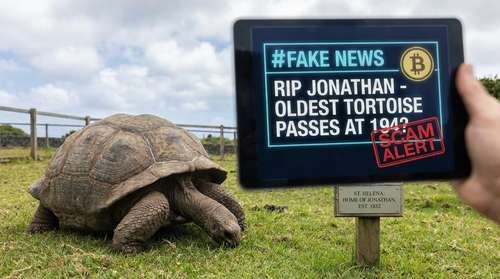
To ease the minds of a distressed global public, the local government took immediate action. Officials released reassuring Jonathan tortoise 2026 updates, confirming that the beloved resident was alive, well, and completely unaware of the digital storm surrounding him. As irrefutable proof of life, the governor's office released a photograph of the reptile resting in the grass next to an iPad displaying the current day's BBC homepage. His shell appeared shiny from the morning moisture, a clear sign of his continued vitality.
Governor Nigel Phillips personally verified that the gentle giant was still enjoying his daily routine at Plantation House. Providing a definitive Jonathan tortoise St. Helena update, caretakers even celebrated his 'resurrection' by treating him to a double portion of his favorite snack: freshly chopped bananas. The island's communications team, led by Anne Dillon, reiterated that strict protocols are in place for sharing official news about the animal's health. She urged the public to ignore unofficial sources and assured everyone that he is 'very much alive.'
Celebrating the World's Oldest Living Land Animal
Hatched around 1832, Jonathan has survived the reigns of eight British monarchs, two World Wars, and the invention of everything from the lightbulb to the internet. He arrived on the remote South Atlantic island of St. Helena in 1882 as a gift from the Seychelles. Archival photographs show he was a fully grown adult upon arrival, carrying an estimated age of 50 years at the time. Today, he holds the official Guinness World Record for his unmatched longevity, serving as a living bridge to the 19th century.
While his eyesight is failing due to cataracts and he has lost his sense of smell, his hearing remains remarkably sharp. He still recognizes the sound of his caretakers' voices, and his appetite for fresh fruits, vegetables, and crisp lettuce is as strong as ever. This recent digital ordeal proves that while modern technology can generate widespread panic in an instant, it cannot match the enduring resilience of a creature that has been quietly grazing through three different centuries. The internet may have tried to fake his demise, but the undisputed king of longevity continues to walk the earth.