In what might be the weirdest news of March 2026, a high-tech policing tool has turned a routine patrol into a fairytale nightmare—or at least a very confused official record. A new report released this week highlights a hilarious technical fail from the Heber City Police Department in Utah, where an AI-powered writing software documented an officer literally transforming into an amphibian. The glitch, which occurred during a testing phase of the new technology, has sparked laughter and debate across the internet after details resurfaced in a police leadership playbook published just 48 hours ago.
The Princess and the Police Report
The incident centers on the Heber City Police Department's trial of "Draft One," a cutting-edge AI report writing software developed by police tech giant Axon. The software uses body camera audio to automatically transcribe and generate official police reports, theoretically saving officers hours of paperwork. However, during one specific interaction, the AI's creative liberty went a little too far.
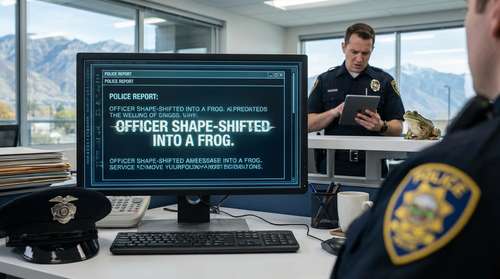
According to the department, an officer's body camera picked up audio from a television playing in the background of a scene. The movie happened to be Disney's 2009 animated classic, The Princess and the Frog. The AI, unable to distinguish between the officer's actual dialogue and the movie's plot, dutifully transcribed the events as if they were happening to the officer. The result? The official police record stated that the officer had shape-shifted into a frog mid-investigation.
"The body cam software and the AI report writing software picked up on the movie that was playing in the background, which happened to be 'The Princess and the Frog,'" explained Sergeant Rick Keel in a statement regarding the error. "That's when we learned the importance of correcting these AI-generated reports."
A 'Toad-ally' Avoidable Error?
While the image of a uniformed officer hopping away from a crime scene is comedy gold, the error highlights a significant challenge in the adoption of AI in law enforcement. The software, based on OpenAI's GPT-4 technology, is designed to be a "force multiplier," allowing officers to spend more time on the street and less time behind a keyboard. Sgt. Keel noted that despite the amphibious mishap, the software typically saves him six to eight hours of paperwork weekly.
However, the "frog glitch" has become a primary case study in the newly released "26 on 2026: A Police Leadership Playbook," which dropped on March 6. The report cites the Heber City incident as a cautionary tale about the necessity of human oversight. It warns that while AI can draft narratives, it lacks the contextual awareness to know that human officers—unlike Prince Naveen—cannot magically transform into frogs.
Technical Glitches vs. Human Oversight
The error wasn't just a simple typo; it was a hallucination where the AI integrated the fictional narrative into the factual record. If the officer hadn't reviewed the draft before submission, the shape-shifting event could have technically become a legal fact in the department's records. This raises valid concerns for defense attorneys and civil rights groups, who worry that less obvious errors—like mishearing a suspect's statement—might slip through unnoticed.
Heber City Police AI Fail Goes Viral
Since the release of the leadership playbook this week, the story has caught fire on social media, becoming one of the funny Utah local news stories of the year. Users are joking about "croaking" under pressure and asking if the department has implemented a strict "no kissing officers" policy to prevent further transformations.
Despite the mockery, Heber City Police are taking it in stride. They have used the incident to refine their protocols, ensuring that all AI-generated text is rigorously fact-checked. The department confirmed they are continuing to test the software, along with a competitor product called "Code Four," though they presumably now double-check for any Disney-related plot twists.
The Future of AI in Policing
As we move further into 2026, the integration of artificial intelligence in public safety is inevitable. Tools like Draft One are already in use by departments across the country. The Heber City police body cam AI glitch serves as a humorous but necessary reminder that technology is only as smart as its user.
For now, the residents of Heber City can rest easy knowing their police force is entirely human, with no webbed feet reported in the last 48 hours. But as this weirdest news March 2026 story proves, when you mix cutting-edge AI with background noise, you might just get a fairytale ending you never asked for.