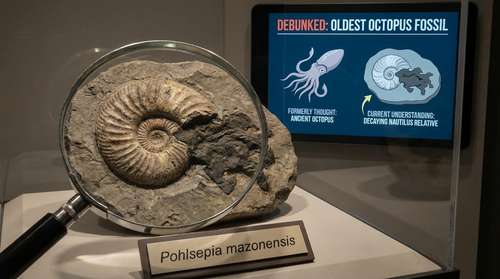
For more than two decades, paleontologists and marine biology enthusiasts alike marvelled at what they believed was the world's oldest octopus fossil. Discovered in Illinois and dating back an astonishing 300 million years, this celebrated specimen fundamentally shaped our understanding of cephalopod evolution. But modern technology just ruined the party. In early April 2026, researchers published groundbreaking scans revealing that the fossil, known as Pohlsepia mazonensis, isn't an octopus at all. It is, in fact, a severely decomposed nautilus relative. This high-profile case of mistaken identity has officially sparked a bizarre Pohlsepia mazonensis debunked scandal, leaving the scientific community scrambling to patch a massive hole in the evolutionary timeline.
A 300-Million-Year-Old ‘Blob’ Deceives Paleontologists
When researchers first formally described the Pohlsepia fossil back in 2000, they were working with what looked like a flattened, palm-sized pile of white mush. Unearthed from the famous Mazon Creek fossil beds just outside Chicago, the imprint superficially resembled a deep-water octopus. Scientists at the time pointed out structures that looked suspiciously like eight tentacles, a pair of eyes, and even an ink sac. The Mazon Creek deposit is world-renowned for its exceptional preservation of soft-bodied organisms, a rarity in paleontology because flesh and muscle typically rot away long before fossilization can occur.
That interpretation made massive waves. It suggested that soft-bodied, eight-armed cephalopods evolved hundreds of millions of years earlier than anyone previously thought—long before the first dinosaurs walked the Earth. For twenty-five years, this 300 million year old fossil served as a crucial calibration point for evolutionary biologists charting the origins of marine life. But as time passed, experts studying the peculiar shape began to quietly question whether the emperor actually had no clothes. To the naked eye, distinguishing between an ancient octopus and an unidentifiable squashed marine organism was a risky guessing game.
Synchrotron Scans Reveal the Toothful Truth
To finally settle the debate, a team led by Dr. Thomas Clements at the University of Reading subjected the famous fossil to cutting-edge synchrotron imaging. This technique uses exceptionally fast-moving electrons to generate beams of light billions of times brighter than standard medical X-rays. The goal was to peer beneath the rock's surface and perform a 300-million-year-old forensic investigation.
What they found shattered the original hypothesis. Hidden deep within the stone was a radula—a ribbon-like feeding structure packed with microscopic teeth, commonly found in mollusks. The radula acts like a microscopic conveyor belt of teeth, allowing these marine predators to scrape and tear their prey. The presence of these teeth offered the ultimate, undeniable clue about the creature's true identity.
Why 11 Teeth Ruined an Octopus’s Reputation
If you want to identify an ancient cephalopod, you count its teeth. Modern and fossilized octopuses consistently feature either seven or nine tooth-like elements per row. When researchers examined the synchrotron data from Pohlsepia, they counted 11 distinct teeth per row. The math simply didn't add up for an octopus.
Instead, the dental arrangement closely matched that of nautiloids, a group of shelled marine animals that typically sport 13 teeth per row. Scientists suspect the specimen lost a couple of teeth while rotting in the prehistoric mud. Ultimately, the team realized the fossil was an exact match for Paleocadmus pohli, a known nautilus relative from the exact same fossil site. The animal had likely died, lost its shell, and decomposed for weeks, warping into an octopus-like shape just before being preserved in the rock forever.
The Ultimate Guinness World Record Fail
The fallout from this discovery has spilled out of academic journals and into mainstream pop culture, marking one of the most entertaining pieces of weird science news 2026 has offered so far. For years, Pohlsepia mazonensis held the prestigious title of the earliest known octopus in the Guinness Book of Records. Millions of readers have flipped through those vibrant pages, completely unaware they were looking at the remains of a rotting nautiloid.
Following the publication of the University of Reading study in the Proceedings of the Royal Society B, Guinness World Records management issued a statement confirming they would be resting the title. While it represents a temporary Guinness World Record fail for the eight-armed cephalopods, the Chicago Field Museum—which houses the fossil—gets a pretty neat consolation prize. They now hold the record for the oldest known soft-tissue preservation of a nautilus.
Mind the Gap: Rewriting Octopus Evolution
While stripping a fossil of its world record is amusing, the scientific implications are surprisingly heavy. Disqualifying Pohlsepia erases a cornerstone of cephalopod history, creating a staggering 150 to 200-million-year octopus evolution gap. Previously, geneticists used the 300-million-year-old benchmark to calibrate molecular clocks—a method used to estimate when species diverged based on genetic mutation rates. Throwing out this timeline means those molecular models must be entirely recalculated. If the oldest octopus wasn't swimming around during the Carboniferous period, when did these highly intelligent predators actually emerge?
The revised timeline now aligns much closer with the Jurassic period. Paleontologists believe the evolutionary split between octopuses and their ten-armed squid cousins happened during the Mesozoic era. Resolving this identity crisis means researchers have to head back to the drawing board—or, more accurately, back to the fossil beds—to hunt for the true ancestor of the modern octopus. Until they find it, the throne for the world's oldest octopus remains entirely empty.