We have all experienced that mild panic when realizing a borrowed novel is a few days late. You rush it back, apologize to the clerk, and maybe pay a couple of dollars. But one Australian family recently set an entirely new benchmark for late returns. In a bizarre and unprecedented discovery, a 150 year overdue library book has finally made its way back to Kiama Library Australia. The exceptionally rare volume was a book found bricked in a fireplace during routine home renovations, ultimately accruing what could be considered a record-breaking twenty eight thousand dollar library fine.
The World's Most Overdue Library Book Resurfaces
Late last month in July 2026, local resident Ross Simmons walked into the public library in the coastal town of Kiama, New South Wales, carrying a piece of local history. He handed over a heavily worn, water-damaged copy of Antiquities of Athens, an architectural survey published in 1858. The book is believed to be the world's most overdue library book, having been missing from circulation for roughly a century and a half.
Kiama Library manager Michelle Hudson was stunned by the return. The book still bore the markings of the institution's earliest collection, identified as item No. 508 from their original catalog of just 1,000 books when the doors first opened in 1872. According to Hudson, librarians often process long-lost materials during estate cleanouts, but those are typically only missing for three or four decades. Seeing a volume that dates back to the library's founding year is virtually unheard of.
A Book Found Bricked in a Fireplace
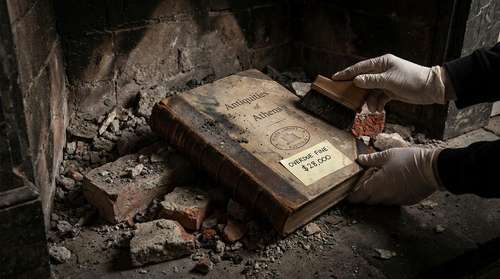
The story of how this copy of Antiquities of Athens overdue status came to be is straight out of a mystery novel. Simmons wasn't simply cleaning out an attic; he discovered the artifact while renovating his historic cottage. The text was carefully tucked away inside a wooden tea crate, which had been intentionally sealed and bricked into a disused fireplace.
Why someone would go to such lengths to hide a book on Greek monuments remains a subject of intense local speculation. While the damp environment of the masonry caused significant water damage over the decades, the thick tea chest provided enough protection to keep the 149 pages and 70 illustrated plates largely intact and readable.
Tracing the Roots to the Simmons Family
Because the library's original 1870s borrowing ledgers were lost to time, staff cannot verify the exact identity of the last official borrower. However, Simmons has a strong theory. He assumes the culprit was his own great-great-grandfather, John Simmons, who lived in the very same cottage during the late 19th century. Because John's children would have been too young to check out complex architectural surveys, the ancestral patriarch is the prime suspect.
Forgiving a Twenty Eight Thousand Dollar Library Fine
If you keep a book for 150 years, the penalties add up quickly. Printed on the inside cover of the recovered volume was a strict warning noting a late fee of three pence per week. Librarians decided to do the math just for fun. Factoring in the original weekly penalty, multiplying it across 150 years, and adjusting for modern inflation, they calculated a staggering twenty eight thousand dollar library fine in Australian currency (roughly $19,500 USD).
Fortunately for Simmons, Kiama Library waived the astronomical debt. Hudson jokingly suggested that the sheer terror of facing such a massive penalty might be exactly why the family decided to entomb the book in a wall rather than return it. In the 1870s, strict local rules dictated that no new materials could be borrowed until all previous overdue debts were settled in full.
Strict 1870s Borrowing Rules Revealed
Beyond the hefty fees, the inside cover of Antiquities of Athens offered a fascinating glimpse into Victorian-era library etiquette. The printed 1872 by-laws were completely unapologetic in their strictness. For instance, a household was only permitted to borrow a maximum of three books at a time, and even then, only if at least six members of the family were "known to be able to read".
- Sobriety Checks: Borrowers were strictly prohibited from checking out materials if they arrived in a "state of intoxication."
- Proof of Literacy: Reading ability had to be vouched for before access to the collection was granted.
- Debt Enforcement: Unpaid fines resulted in an immediate and total ban from the premises.
Today's library policies are thankfully much more relaxed, prioritizing community access and inclusion over literacy tests and sobriety checks. As for the historic Greek architecture volume, its days of circulating through the seaside town are officially over. Rather than putting it back on the shelves, Kiama Library is placing the delicate book into archival-quality boxes, preserving this remarkable 150-year-old time capsule in their Local Studies collection forever.