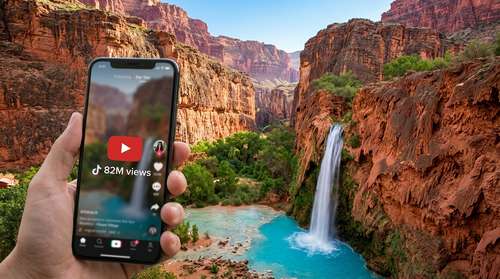
If you spend enough time scrolling through social media, you are bound to stumble upon a revelation that makes you question your entire educational background. This weekend, that digital awakening arrived courtesy of an Ariel Nicole TikTok video that practically broke the internet. The creator shared her sheer disbelief upon discovering that there are actual Grand Canyon residents living permanently at the base of the massive Arizona landmark. Her zoomed-in footage of structures nestled deep within the chasm has triggered a collective gasp online, proving that millions of people had absolutely no idea that human settlements existed in one of America's most famous natural wonders.
The "Today Years Old" Viral Moment That Broke the Internet
For those who missed it, the video posted by @heyarielnicole features a stunning drone-like pan across the iconic red rock formations. Suddenly, the camera pushes in, revealing a cluster of buildings dwarfed by the massive canyon walls. The text overlaying the clip admits she was "today years old" when she learned the truth.
Her caption perfectly captured the mood of her audience: "I must have skipped school this day because I did not know this lol! Did y'all know people live in the Grand Canyon?".
The internet's response was swift and staggering. As of mid-March 2026, the clip has amassed over 82 million views, transforming into a massive today years old viral phenomenon. The comments section rapidly filled with bewildered viewers confessing their own ignorance. Many assumed the area was strictly a protected national park reserved for hikers, river rafters, and photo-seeking tourists. This spectacular TikTok geography fail highlights a fascinating blind spot in public knowledge, turning a remote community into an overnight sensation.
Unveiling the Grand Canyon Mystery Village
The settlement capturing everyone's attention is not a new development or a secret government bunker. The Supai Village viral explosion has simply shone a spotlight on a community that has called the canyon home for centuries. Situated deep within a remote gorge, Supai serves as the capital of the Havasupai Tribe.
Unlike typical American towns, this Grand Canyon mystery village is famously inaccessible by road. You cannot simply drive your car down to the local grocery store. Residents and permitted visitors must navigate an arduous eight-mile trail by foot, ride a mule, or charter a helicopter to reach the canyon floor. The community operates entirely outside the boundary and jurisdiction of Grand Canyon National Park.
Currently, the town boasts a population of roughly 200 residents. Despite its intense isolation, the village maintains essential infrastructure. Those living at the base have access to a small store for basic goods, a functioning school, a café, and a post office—which holds the unique distinction of being the only post office in the United States where mail is still delivered via mule train.
The Reality of Being Grand Canyon Residents
While Ariel Nicole TikTok viewers might see the village as a fascinating novelty, everyday life here requires immense resilience. As the conversation around the viral clip grew, social media users quickly pointed to creators who actually experience this lifestyle firsthand.
Shila S. Siyuja, a woman who genuinely calls the canyon home with her family, has built her own following by documenting the stark realities of her unique zip code. Her videos offer a grounded perspective that contrasts sharply with the drone footage of passing tourists. In one particularly eye-opening post, Siyuja chronicles her family undertaking the grueling eight-mile hike home simply because they missed their scheduled flight into the canyon.
Living in such a secluded environment means trading convenience for unparalleled natural beauty. The Havasupai are surrounded by striking turquoise waterfalls that look almost otherworldly against the ancient red rock. Yet, running out of household essentials means waiting for a delivery or arranging transport. It is a profound, challenging existence that tourists rarely consider when snapping photos from the rim above.
A Digital Geography Lesson
The sheer scale of the reaction to this revelation speaks volumes about how we interact with natural landmarks. Every year, millions of travelers flock to northwestern Arizona to stare into the 277-mile-long chasm carved by the Colorado River. They buy souvenirs, hike the upper trails, and drive back to their hotels. Very few pause to consider the indigenous populations who never left.
Social media often gets a bad reputation for spreading misinformation, but occasionally, an algorithm serves up a genuine learning moment. The widespread shock over the fact that people live in the Grand Canyon has sparked renewed interest in the Havasupai Tribe's history and their ongoing stewardship of the land.
For the 82 million people who watched a quick, zoomed-in video this week, the canyon is no longer just a geological marvel or a backdrop for vacation selfies. It is a living, breathing neighborhood. The next time you visit a famous landmark, you might find yourself wondering who actually calls that spectacular view their permanent backyard.