
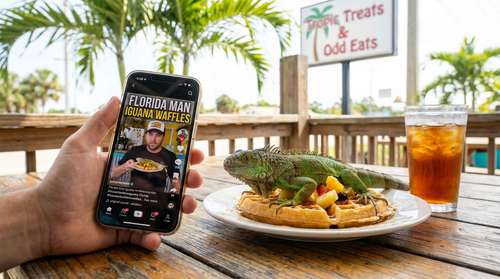
The internet is no stranger to wild culinary experiments, but a newly viral social media clip has officially blurred the line between breakfast and pest control. In a video rapidly circulating social media this April 2026, a South Florida resident pairs golden, syrupy breakfast waffles with freshly cooked invasive green iguanas. It is the latest weird news 2026 has offered, leaving audiences both fascinated and thoroughly disturbed while shining a light on the state's ongoing ecological battles.
The Iguana Waffles Video That Broke the Internet
The viral Florida video features an unnamed Miami-Dade resident—swiftly dubbed the ultimate "Florida Man"—demonstrating his highly unusual morning routine. After humanely harvesting a lizard from his backyard, he meticulously skins, cleans, and seasons the meat before pan-frying it. The grand finale involves plating the crispy reptile alongside buttery Belgian waffles and drowning the entire dish in maple syrup. The man casually refers to the meal as "the ultimate sweet and savory breakfast," sparking a bizarre food trend that no one saw coming.
Commenters across platforms are polarized. While some users are horrified by the visual of a pan-seared reptile taking the place of traditional bacon or sausage, others are morbidly curious about the taste. This unexpected viral Florida video has reignited debates about how locals manage the explosive population of non-native wildlife, proving that bizarre food trends often emerge from practical, if extreme, problem-solving.
The Ecological Reality Behind Florida Lizard Culling
While the internet reacts with collective shock, the reality behind this iguana waffles video is rooted in a massive ecological crisis. The invasive green iguana is wreaking havoc across the Sunshine State. The Florida Fish and Wildlife Conservation Commission (FWC) actively encourages the removal and humane killing of these reptiles on private property. They are not native to Florida, having been introduced largely through the exotic pet trade starting in the 1960s.
Today, these reptiles cause millions of dollars in infrastructure damage by digging extensive burrows that erode sidewalks, crack seawalls, and undermine building foundations. Furthermore, they decimate native plant life and consume the eggs of endangered ground-nesting birds. Because of these environmental threats, Florida lizard culling has become a normalized, everyday necessity for landscapers and homeowners alike.
Strict Guidelines on Humane Harvesting
While the state wants the invasive green iguana gone, officials emphasize that population control must be done ethically. The FWC strictly prohibits cruel unapproved killing methods such as freezing, drowning, or suffocation, noting that such actions violate Florida's animal cruelty laws. Additionally, it is illegal to trap these animals and re-release them into public parks or canals. If residents choose to act, they must either humanely euthanize the pest on-site or hire professional wildlife trappers.
"Chicken of the Trees": The Origins of a Bizarre Food Trend
To long-time locals, consuming these reptiles isn't an entirely new concept, even if the waffle pairing is definitely unorthodox. In parts of Central and South America, as well as the Caribbean, iguana meat has a long-standing culinary reputation and is considered an economical source of protein.
Dubbed the "chicken of the trees" because the lean meat reportedly tastes strikingly similar to poultry, these reptiles are highly nutritious. In fact, iguana meat contains more protein and less fat than standard chicken. The University of Florida's Institute of Food and Agricultural Sciences (UF/IFAS) has previously noted the benefits of eating the invasive pest, even publishing beginner-friendly recipes for iguana tacos and burritos. The growing "invasivore" diet—eating invasive species to help save the local ecosystem—is gaining traction, but throwing them on a waffle iron certainly takes this bizarre food trend into uncharted territory.
Health Warnings for Aspiring Invasivores
Before you grab a skillet and head to your backyard to replicate this weird news 2026 phenomenon, wildlife and health experts have a few serious warnings. Just like raw poultry, wild-caught invasive green iguanas can carry harmful bacteria and parasites, most notably Salmonella.
Food safety experts emphasize that the meat must be handled with strict hygiene protocols. To neutralize health risks, the meat must be cooked thoroughly to a safe internal temperature of at least 165 degrees Fahrenheit. Health officials firmly advise against raw or semi-raw preparations like iguana ceviche, pointing out that acidic marinades alone cannot kill the potential pathogens present in wild reptiles.
Is the Viral Florida Video Helping the Ecosystem?
Whether the broader Florida lizard culling effort will genuinely benefit from this viral breakfast stunt remains to be seen. While the initial shock value of the iguana waffles video has guaranteed its spot in the internet hall of fame, it also serves an educational purpose. It shines a much-needed spotlight on the severe ecological threat these invasive pests pose to the local environment and opens a conversation about sustainable, if unusual, solutions.
The concept of eating invasive species isn't just a gimmick; it is a legitimate conservation strategy promoted by ecologists worldwide. By turning pests into a food source, communities can alleviate the pressure these animals put on native wildlife. The Florida Man's creative culinary approach may inspire others to view the invasive green iguana not just as a destructive nuisance, but as a potential—albeit unconventional—resource. For now, this Florida Man remains an internet legend, proving once again that when life gives you a backyard full of invasive reptiles, sometimes the most logical response is to heat up the syrup.