If you've traveled through southwestern Missouri recently, you might have encountered a scent so potent it feels like hitting a physical barrier. What started as a standard highway traffic accident has mutated into one of the most bizarre environmental cleanups in recent memory. Residents and officials are officially at war with the Jerome Tofu Monster—a massive, 40,000-pound pile of extra-firm tofu that was left to ferment in a roadside ravine for over three weeks. This unusual Missouri tofu spill accident has captured national attention, firmly securing its place in the pantheon of weird news Missouri history.
The Birth of the Jerome Tofu Monster
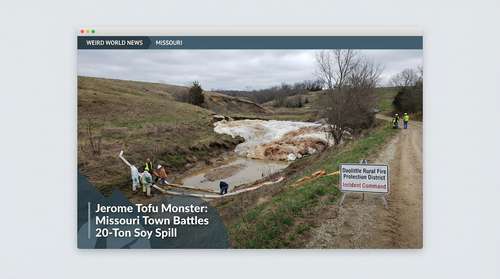
The saga began on March 1, 2026, when a commercial tractor-trailer hauling a massive cargo of soy products lost control on Interstate 44. Navigating near exit 172 in the small community of Jerome, the big rig smashed through a guardrail and plunged down into a creek bed that feeds into the nearby Gasconade River. Thankfully, the driver was unharmed, and emergency responders quickly contained a minor oil leak from the truck's engine. However, the violent impact ripped the trailer open, ejecting 20 tons of packaged soy into the brush and water below.
Under normal circumstances, hazardous or obstructive cargo is removed from state highways within hours. But this particular cleanup quickly devolved into a logistical nightmare. For more than three weeks, towing companies and the trucking carrier's insurance providers engaged in a bitter financial dispute over who would foot the bill for the complex extraction. As corporate red tape stalled the recovery effort, the colossal pile of food was left completely exposed to the elements.
To put this into perspective, 40,000 lbs extra firm tofu is the weight equivalent of a mid-sized bulldozer made entirely of bean curd. Slowly, the spring heat transformed the benign, protein-rich blocks into a rotting, pulsating environmental hazard that demanded immediate attention.
Battling a 'Brick Wall' of Rotting Tofu Smell
As the days turned into weeks, the payload began to aggressively decompose. The Doolittle Rural Fire Protection District, tasked with monitoring the precarious situation, quickly realized they had a biological catastrophe on their hands. Taking to social media to update the public, first responders officially christened the putrid disaster site as the "Jerome Tofu Monster" and dubbed the remediation effort "the Great Battle of Jerome".
Locals and cleanup crews have described the rotting tofu smell as an invisible "brick wall" of odor that physically repels anyone approaching the perimeter. Doolittle Fire Chief Brandon Williams didn't mince words when speaking to the press about the relentless stench. "It was like a dead animal, but worse," Williams stated. "It's probably one of the worst smells I've smelled in my life, and I've smelled some nasty stuff".
The biological breakdown of plant-based proteins generates highly volatile compounds, turning the peaceful ravine into a foul-smelling swamp. The situation escalated when authorities noted that decomposing soy and debris had begun washing downstream. In official statements, the fire district noted that the creature "resisted capture with surprising strength," leading officials to cautiously label the downstream aquatic runoff zone as a "tofu-affected area".
Missouri's Bizarre Curse of 40,000-Pound Food Spills
While the Jerome MO weird world news making headlines today is undeniably strange, locals are pointing out a baffling and hilarious historical coincidence. The Doolittle Rural Fire Protection District is strangely accustomed to dealing with epic, 20-ton grocery disasters.
Just last year, a nearly identical incident occurred roughly 20 miles away on the exact same interstate. In that previous crash, a different commercial truck met a disastrous fate while hauling exactly 40,000 pounds of ribeye steaks. However, unlike the current rotting soy crisis, the meat truck erupted into a massive inferno. As commentators have jokingly pointed out, Missouri emergency crews have now battled both a 20-ton roadside barbecue and a 20-ton fermented tofu nightmare in the span of a single year. Given the choice, most responders readily admit they preferred the smell of burning steak to the relentless assault of the tofu monster.
The Road to Recovery and Remediation
Finally, after weeks of bureaucratic delays and mounting public complaints, state agencies mobilized to slay the beast. The Missouri Department of Transportation, alongside the Highway Patrol and the State Emergency Management Agency, stepped in to coordinate the complex extraction.
Removing the fermented payload requires specialized heavy machinery to dredge the creek bed while simultaneously managing the horrific stench. Cleanup crews are working tirelessly to scrape up the remaining organic matter and sanitize the surrounding soil. While the main mass of the cargo has been contained, officials warn that the environmental remediation of the tofu-affected area will likely take additional time.
The epic tale of the Jerome Tofu Monster serves as a bizarre reminder of the fragile nature of our national supply chains—and the terrible aromatic consequences of insurance disputes. For the residents of this quiet Missouri community, the infamous soy spill of 2026 will undoubtedly remain an unforgettable chapter of local lore.