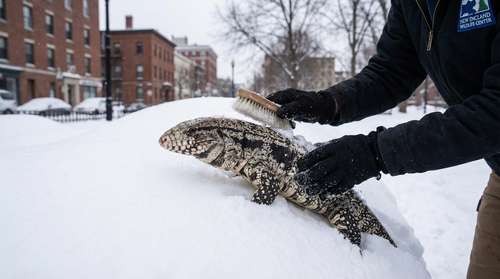
In a story that is baffling wildlife experts and warming hearts across New England, a 4-foot exotic lizard has survived being buried under nearly two feet of snow in Providence, Rhode Island. Dubbed the "lizard in a blizzard," the Argentine black-and-white tegu was discovered alive but critically condition by a local resident shoveling out from this week's historic nor'easter. The miraculous survival of this tropical reptile, now recovering at the New England Wildlife Center, has become a viral sensation, highlighting both the resilience of nature and the dangers of exotic pet abandonment.
A Shocking Discovery Under 20 Inches of Snow
The discovery was made earlier this week by Providence resident Francis Hardy, who was clearing his driveway after the massive winter storm that blanketed the region. As his shovel cut through the heavy drifts, he didn't hit pavement—he hit scales. Buried beneath approximately 20 inches of snow and ice was a massive, black-and-white reptile, rigid and motionless.
"It was like rigid, like a board, freezing cold to the touch," Hardy reported to local news outlets. Most residents would expect to find a lost mitten or a buried branch, not a massive South American lizard. Realizing the animal might still have a fighting chance, Hardy acted quickly. He brought the comatose reptile indoors, wrapped it in a warm t-shirt to gently raise its body temperature, and immediately contacted local reptile experts.
Critical Care at the New England Wildlife Center
The rescue effort quickly expanded as Emily Arpin and Taylor Faria, co-owners of ET Reptiles in nearby Warwick, responded to the call. They transported the lizard—now affectionately named "Frankie"—to the New England Wildlife Center (NEWC) for emergency veterinary care. The medical team was stunned that the animal was alive at all. Being cold-blooded, tegus rely on their environment to regulate body temperature; sub-freezing conditions typically cause rapid cell failure and death.
Veterinarians at the center found Frankie in a perilous state. The lizard was described as "extremely weak, underweight, and not moving well." The extreme cold had taken its toll, resulting in cold-induced myopathy—a condition where muscles suffer damage due to inadequate circulation and energy depletion. Additionally, Frankie suffered severe frostbite, particularly to his tongue.
"He had suffered frostbite to his tongue and showed signs of significant muscle weakness after prolonged exposure to the cold," the wildlife center explained in a statement. To save him, doctors had to amputate a portion of his tongue and began an aggressive course of steroids and antibiotics to combat inflammation and potential infection.
Why This Survival Is a Biological Anomaly
The Argentine black-and-white tegu is native to the rainforests and savannas of South America, thriving in heat and humidity. While they do undergo a period of dormancy called brumation during cooler months, they burrow underground to stay safe. They are absolutely not equipped to survive direct exposure to New England's freezing blizzard conditions.
Wildlife biologists note that this species has become invasive in warmer states like Florida, often due to pet owners abandoning them when they grow too large. Tegus can reach up to four feet in length and live for 20 years, making them a significant commitment that many unprepared owners eventually shirk. Experts suspect Frankie was likely an abandoned pet or an escapee who had the misfortune of being loose during one of the worst storms of the year.
The fact that Frankie survived buried in snow for an unknown duration contradicts what is typically biologically possible for the species. "This is not something even the most snow-hardened New Englander would expect to find," the NEWC remarked, underscoring the rarity of the event.
Frankie's Road to Recovery
As of Sunday, updates on Frankie's condition are cautiously optimistic. ET Reptiles reported seeing "small but encouraging changes" in his behavior. He is reportedly more alert and resting comfortably in a warm, controlled environment, which vets say "makes all the difference."
However, the road ahead is long. The severe metabolic stress and tissue damage from the freeze mean Frankie is not out of the woods yet. His recovery will require weeks of supportive care, specialized feeding due to his tongue injury, and constant monitoring for secondary infections.
This "Providence lizard find" serves as a stark reminder of the responsibilities of exotic pet ownership. While the internet celebrates the resilience of this "lizard in a blizzard," animal control officials urge the public never to release non-native species into the wild, where they face almost certain death or pose threats to local ecosystems.