If you thought the human fascination with shiny gemstones and healing minerals was a purely modern trend, science has a surprising update for you. In what is already being hailed as the most captivating nature discovery 2026 has given us, primatologists have officially documented a groundbreaking behavioral shift in our closest evolutionary relatives. A new study reveals that chimpanzees are actively collecting, hoarding, and seemingly admiring quartz crystals.
This unprecedented documentation of a chimpanzee crystal ritual challenges everything biologists thought they knew about animal cognition. Rather than using these stones to crack nuts or forage for insects—traditional tool-use behaviors long observed in the wild—the primates appear to value the crystals purely for their aesthetic or proto-spiritual properties. It is a stunning revelation that immediately took over social media, adding a fascinating new chapter to primate spirituality news.
Inside the Bizarre Animal Crystal Obsession
The research, published in early March 2026 in Frontiers in Psychology, was led by Juan Manuel García-Ruiz, a professor of crystallography at the Donostia International Physics Center in San Sebastián. His team observed nine enculturated chimpanzees at Rainfer Fundación Chimpatía, a primate rescue facility in Spain, presenting them with a mix of ordinary rocks, pebbles, and distinct minerals like quartz, pyrite, and calcite.
What happened next was nothing short of astonishing, making it a standout story in weird world animal news. The apes didn't just casually inspect the new items; they displayed a profound, immediate preference for the translucent and shiny stones. When presented with a pile of twenty ordinary pebbles mixed with a few crystals, the chimps separated the minerals in a matter of seconds. They deliberately categorized the crystals based on their luster, symmetry, and varying degrees of transparency, completely isolating them from the duller rocks.
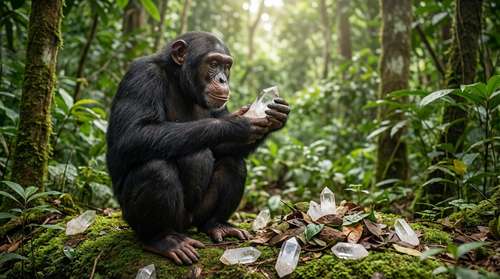
The apes handled the quartz with intense care. Researchers watched as the animals held the transparent stones up to the light, gazing through them at eye level. Some chimps carried the prized possessions in their mouths—a rare behavior usually reserved for highly valuable items—transporting them to their sleeping dormitories to stash them safely. Getting the stones back proved difficult; scientists had to barter with substantial amounts of favorite snacks like bananas and yogurt just to convince the apes to relinquish their new treasures.
From Primate Habitats to Viral Monkey Videos
It didn't take long for the footage of these apes admiring their quartz hauls to leak into the mainstream. Clips of the apes meticulously sorting their stones and peering into translucent calcite quickly joined the ranks of the most popular viral monkey videos across platforms like TikTok and Reddit.
Online communities have jokingly dubbed the apes the original 'crystal girlies,' marveling at the relatable way the chimpanzees curate their shiny collections. The intersection of online crystal culture and genuine zoological science has turned this animal crystal obsession into a massive cultural talking point. People are captivated by the idea that an ape might feel the same sense of wonder when looking into a quartz prism as a human does.
Tracing the Roots of Evolutionary Aesthetics
Beyond the internet memes, the scientific implications of this weird animal behavior 2026 research are staggering. Humans have been collecting crystals for hundreds of thousands of years. Archaeologists routinely find unworked quartz and other visually striking minerals at ancient hominin sites dating back as far as 780,000 years. Until now, the motivation behind this prehistoric hoarding remained a mystery.
García-Ruiz's findings suggest that the neurological foundation for appreciating beauty, symmetry, and luminosity predates the divergence of our species. The chimpanzees are demonstrating an intrinsic appreciation for the physical properties of an object that serves absolutely no survival, nutritional, or defensive purpose.
This abstraction is a massive leap in animal psychology. When an ape assigns value to a non-functional object simply because it is beautiful to look at, they are crossing a cognitive threshold. Anthropologists are debating whether these deliberate decorative patterns and hoarding tendencies represent a form of sensory play, or if we are witnessing the very earliest stages of proto-religious behavior.
What This Means for the Future of Primatology
While researchers caution against overly anthropomorphizing the apes—reminding the public that these specific subjects have had significant contact with humans—the sheer instinctual drive they showed for the crystals cannot be ignored. The attraction appears entirely natural, deeply rooted in their biology.
As scientists continue to monitor these colonies, the primary goal is to determine if completely isolated wild populations exhibit similar hoarding patterns without any human prompting. Previous field studies have occasionally noted chimpanzees throwing rocks at specific 'sacred' trees, creating localized stone accumulations. If primatologists can link those wild stone-throwing rituals to this new crystal-sorting behavior, the line separating human spirituality from animal instinct will blur even further. The possibility that wild apes are maintaining secret caches of pyrite and quartz deep in the African rainforest is driving a renewed wave of funding and interest in primate cognition. For now, the image of a chimpanzee holding a crystal up to the sunlight remains one of the most powerful and thought-provoking scientific visuals of the year.