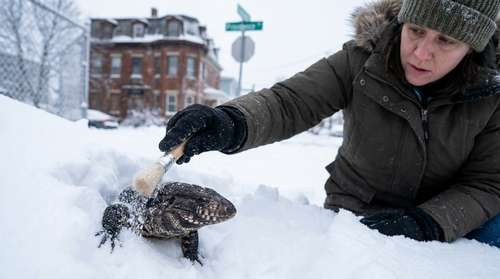
When Francis Hardy stepped outside to shovel his Providence driveway after a massive winter storm, he expected to find nothing but piles of white powder. Instead, he uncovered a scaly surprise that has since captured the hearts of New England: a large South American tegu lizard buried alive under nearly two feet of snow. The miraculous recovery of the reptile, now affectionately dubbed the "Lizard in a Blizzard," has become a viral sensation and a testament to unlikely survival in the face of brutal Rhode Island news headlines.
A Shocking Discovery in Providence
The incident unfolded on a Tuesday morning following a historic weekend blizzard that blanketed Rhode Island in approximately 20 inches of snow. Hardy was clearing his driveway on a busy Providence street when he spotted a strange shape struggling to emerge from the drift. At first glance, he thought it might be a toy or debris, but a closer look revealed a black-and-white reptile, stiff and barely moving.
Recognizing the animal was in critical distress, Hardy acted quickly. "I said to myself, 'You have to hurry up and get down there and rescue this thing because it's not going to survive,'" Hardy recalled. He scooped up the freezing creature, brought it inside, and wrapped it in a warm T-shirt. Using heating pads and even a hair dryer on a low setting, he began the delicate process of raising the cold-blooded animal's body temperature before contacting local experts.
Critical Care at New England Wildlife Center
Hardy reached out to ET Reptiles, a local specialty store, whose owners Taylor and Emily immediately responded to transport the tegu to the New England Wildlife Center (NEWC) for emergency medical treatment. Veterinary staff were stunned that the tropical animal had survived the sub-zero conditions for what could have been days.
Upon arrival, the tegu—now named "Frankie" in honor of her rescuer—was in critical condition. Dr. Greg Mertz and the veterinary team identified several life-threatening issues:
- Severe Frostbite: Frankie's tongue and several toes had suffered significant tissue damage from the extreme cold.
- Cold-Induced Myopathy: A condition where muscle tissue breaks down due to inadequate circulation and energy, leading to extreme weakness.
- Respiratory Infection: A common but deadly complication for reptiles exposed to freezing drafts.
The Medical Battle for Survival
To save Frankie, vets had to perform a partial amputation of her frostbitten tongue. She was placed on a regimen of antibiotics and steroids to combat inflammation and infection. "Reptiles are cold-blooded, meaning they rely on their environment to regulate their body temperature," a spokesperson for the NEWC explained. "When temperatures drop too low for too long, their metabolism slows, blood flow is compromised, and cells begin to fail."
Despite the odds, Frankie has shown small but encouraging signs of improvement. In a recent update, caretakers noted she is becoming more alert and active, though her road to full recovery remains long. The tegu lizard rescue highlights the resilience of these animals, even when faced with environments totally foreign to their native South American habitats.
Weird Local News: Abandoned or Escaped?
As Frankie recovers, a mystery remains: How did a tropical lizard end up buried in a Rhode Island snowbank? Tegus are popular exotic pets known for their intelligence and dog-like temperament, but they are ill-equipped for New England winters. Animal control officers and the NEWC are investigating whether Frankie was an escapee from a nearby home or a victim of abandonment.
This case of weird local news serves as a stark reminder of the responsibilities involved in exotic pet rescue and ownership. Experts warn that tropical animals should never be released into the wild, especially in climates where they cannot survive. For now, no owner has come forward to claim Frankie.
Animal Survival Stories Warm Hearts
Frankie's story has resonated far beyond Providence, RI, joining the ranks of incredible animal survival stories. Community members have rallied around the "Lizard in a Blizzard," offering donations and well-wishes for her recovery. The swift actions of Francis Hardy and the dedicated veterinary team turned what would have been a frozen tragedy into a hopeful narrative of compassion.
While Frankie isn't out of the woods yet, her fighting spirit has given her a second chance. For residents of Rhode Island, the image of a tropical lizard being pulled from a snowdrift is a memory that won't soon melt away.