
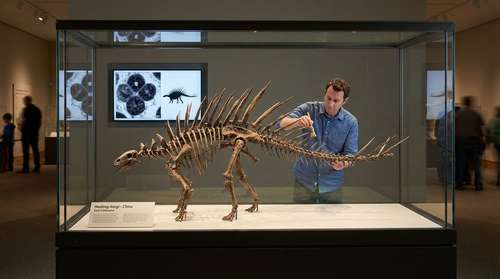
Paleontologists in China have unearthed what might be the weirdest dinosaur of 2026: a 125-million-year-old herbivore rocking a natural suit of armor that looks suspiciously like a punk rock mohawk. This breaking spiky dinosaur discovery, announced this week, introduces the world to Haolong dongi—a creature that defies everything we thought we knew about dinosaur skin.
Found in the world-famous Jehol Biota of northeastern China, the fossil is so exquisitely preserved that researchers can see individual fossilized skin cells under a microscope. But the real showstopper? The animal was covered in bizarre, hollow dinosaur spikes similar to porcupine quills, a feature never before documented in the history of paleontology. This discovery is rewriting the textbooks on prehistoric life, proving that the Early Cretaceous was far wilder—and spikier—than we ever imagined.
The "Spiny Dragon" of the Jehol Biota
The new species, named Haolong dongi (meaning "spiny dragon" in Mandarin), was discovered in the Yixian Formation of Liaoning Province, a region often called the "Pompeii of dinosaurs" for its incredible fossil preservation. The specimen is a juvenile, measuring about 2.45 meters (8 feet) long, and lived approximately 125 million years ago. While it belongs to the Iguanodontia group—cousins of the famous thumb-spiked Iguanodon—Haolong looked drastically different from its relatives.
Unlike the scaly skin typically associated with this group, Haolong dongi sports a collection of hollow, horn-like spikes protruding from its skin. These aren't bones; they are cutaneous structures made of keratin, the same material as human fingernails. This finding marks the first time such structures have been found in a dinosaur, earning it the nickname of prehistoric punk rock icon among the scientific community.
Hollow Spikes: A Unique Evolutionary Twist
The most shocking aspect of this China fossil news is the structure of the spikes themselves. Traditional dinosaur armor, like that of an Ankylosaurus, is made of solid bone plates known as osteoderms. Haolong's armor is completely different. High-resolution imaging revealed that these spikes were hollow and cylindrical, growing directly from the skin rather than the skeleton.
"These spikes differ structurally from known protofeathers in non-avian dinosaurs and scaly spines in extant squamates," the researchers noted in their report. Ranging from tiny bristles to larger quills up to 4.5 centimeters long, these appendages likely served as a defense mechanism. In an ecosystem teeming with sharp-toothed predators like the feathered tyrant Yutyrannus, looking like a prickly pincushion would have been a distinct survival advantage. This "porcupine defense" suggests that Haolong was a tough snack for any carnivore to swallow.
High-Definition History: Fossilized Skin Cells
While the spikes are visually stunning, the microscopic details of the fossil are scientifically revolutionary. The preservation is so pristine that it offers a "high-definition" look at the past. Researchers used X-ray scans and histological sections to identify fossilized skin cells preserved right down to the nucleus.
This level of detail allows scientists to see the cellular machinery of a creature that died 125 million years ago. They observed keratinocytes (skin cells) and even the nucleoli within the cell nuclei. This rare glimpse into dinosaur biology confirms that Haolong's spikes were complex skin appendages, highlighting an evolutionary creativity in dinosaur integument (skin covering) that was previously unknown.
Breaking the Rules of Dinosaur Skin
For decades, paleontologists believed that ornithischian dinosaurs (the group containing Triceratops, Stegosaurus, and Iguanodontians) were primarily scaly, while feathers were the domain of theropods (like T-Rex and birds). Haolong dongi complicates this picture beautifully. Its hollow spikes are neither simple scales nor true feathers. Instead, they represent a completely unique third category of body covering.
This discovery suggests that the genetic toolkit for creating complex skin structures was widespread among dinosaurs. It paints a picture of the Early Cretaceous period as a time of intense biological experimentation, where evolution was trying out everything from fuzzy feathers to hollow quills to see what worked best.
Why This Discovery Matters Now
As the weirdest dinosaur of 2026, Haolong dongi reminds us that we have barely scratched the surface of the fossil record. Just when we think we understand the "rules" of dinosaur anatomy, a discovery like this comes along to break them. The hollow spikes challenge existing theories about how dinosaur skin evolved and functioned, potentially pointing to roles in thermoregulation (cooling the body) or visual display, in addition to defense.
This spiky dinosaur discovery highlights the importance of the Jehol Biota and the cutting-edge technology now available to paleontologists. By looking closer—literally at the cellular level—scientists are turning stone bones into living, breathing animals with complex lives and anatomies. Haolong dongi may be millions of years old, but as nature's original punk rocker, it's never looked fresher.