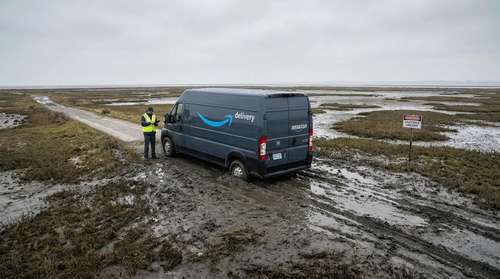
In what might be the ultimate candidate for weird news 2026, a local Amazon delivery driver has become an unwitting internet sensation after following their navigation system directly into a treacherous tidal zone. The viral incident, which resulted in an Amazon van stuck in rising waters, highlights the sometimes hilarious but dangerous consequences of blindly trusting digital maps. Footage of the submerged vehicle has sparked a massive online debate about navigation mishaps and the pressure on delivery drivers to meet tight deadlines.
The Viral Moment: Amazon Van Stuck in the Mud
The ordeal began when the driver, attempting to deliver a package to a remote location, followed their GPS instructions away from the main road and onto a notorious path known as "The Broomway." While the route appeared as a valid shortcut on the screen, the reality was a terrifyingly soft mudflat that is completely submerged during high tide. Within minutes, the heavy electric delivery vehicle lost traction and sank deep into the sludge, leaving the driver stranded as ocean waters began to lap at the tires.
Local onlookers and coastguard officials were stunned to see the blue-branded van bobbing in the estuary. "It happens more often than you'd think," said a local resident who witnessed the aftermath. "The GPS sees a line, but the tide sees a swimming pool." The delivery driver fail was captured on video and quickly circulated on social media, accumulating millions of views within hours.
The "Deadliest Footpath": A GPS Fail News Legend
The location of this blunder adds a layer of terrifying context to the funny local news story. The Broomway, located in Essex, UK, is historically dubbed the "deadliest footpath in Britain," having claimed over 100 lives over the centuries due to its disorienting tides and quicksand-like mud. It is definitely not a driveway for a Prime delivery.
Authorities confirmed that the driver was trying to reach Foulness Island. The path is technically a public right of way, which explains why some navigation mishaps occur—algorithms don't always distinguish between a hiking trail for expert guides and a paved road for a 3-ton van. Fortunately, the driver managed to escape the vehicle safely before the tide fully came in, avoiding injury but leaving the van to the mercy of the elements until a recovery could be mounted.
The Rescue Mission
Recovering the Amazon van stuck in the mud was no small feat. A complex rescue operation involving local farmers and heavy-duty towing equipment was launched once the tide receded. Images of a tractor dragging the muddy, soggy van back to solid ground have become the latest meme fodder, symbolizing the struggle of technology versus nature.
Why This Story is Trending as Houston Offbeat News
While the incident occurred across the pond, it has resonated globally, becoming a hot topic in Houston offbeat news circles this week. Houstonians, no strangers to flooding and navigation hazards around bayous, have found a kindred spirit in the unfortunate driver. The story serves as a cautionary tale for gig workers everywhere: when the map says "turn right" into a swamp, trust your eyes over the screen.
Major outlets in Texas have picked up the story, comparing it to local incidents where drivers have ended up in retention ponds or stuck on flooded feeder roads. It serves as a grimly humorous reminder that whether you are in the UK mudflats or navigating a stormy Gulf Coast highway, common sense is the best co-pilot.
Tech Over-Reliance: A Growing Problem in 2026
This weird news 2026 entry isn't an isolated event. As delivery networks expand and rely more heavily on AI-driven routing, drivers are increasingly sent down unpaved, private, or dangerous paths to shave seconds off delivery times. Experts warn that without better data verification, we will see more vehicles swallowed by the landscape.
Amazon has issued a statement confirming the driver is safe and that they are investigating the routing error. Meanwhile, the internet continues to enjoy the saga of the "Amboat," proving that even trillion-dollar logistics networks can be defeated by a bit of mud and a rising tide.