
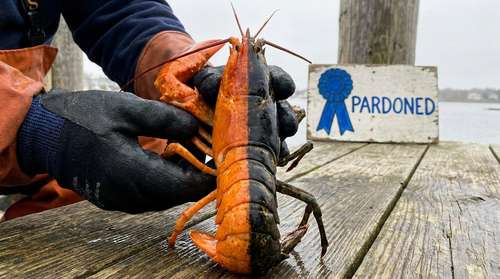
Over the last 48 hours, social media feeds have been flooded with images of a crustacean that looks like it was painted perfectly down the middle. For fishermen working the waters of New England, bringing up oddball catches is just part of the job. But a stunning two-colored lobster Cape Cod crews pulled from the Atlantic has defied all mathematical odds, sparking a massive wave of public interest just in time for the summer fishing season.
Instead of hitting the dinner table with a side of melted butter and lemon, this spectacular creature is getting a second lease on life. The animal, boasting a shell divided perfectly into two distinct colors, was officially pardoned by the seafood company that brought it to shore. Here is everything you need to know about the ocean's latest viral celebrity.
A One-in-50-Million Catch Off the Massachusetts Coast
The story began when lobstermen working aboard the fishing vessel Timothy Michael were hauling up their traps just off the Massachusetts coast. Among the standard mottled-brown catch was an absolute showstopper. The crew quickly realized they had a rare split lobster viral sensation on their hands. One half of the animal's body features the typical dark, muddy brown that helps American lobsters camouflage on the seafloor. The other half glows with a bright, vibrant orange-red—the exact shade usually only seen after a lobster has been boiled.
This striking split runs cleanly down the center of the lobster, from the tip of its antennae all the way to its tail fan. The crew turned the fascinating find over to the Wellfleet Shellfish Company in Eastham, Massachusetts. Almost immediately, the team recognized that they were dealing with an extraordinary genetic anomaly. Rather than sending the three-pound behemoth to the local market, the company quickly decided the animal deserved a much better fate.
"When something that rare comes across our docks, we see it as part of our role to share it with the broader community," stated Wellfleet Shellfish Company COO Dan Brandt. Their swift decision created the perfect fodder for Cape Cod funny local news, transforming a routine fishing trip into a heartwarming rescue mission.
The Science Behind the Orange and Black Lobster
While the fishing community frequently encounters Massachusetts seafood oddities—including blue, calico, and even pastel "cotton candy" lobsters—this distinct half-and-half pattern is exceptionally scarce. Marine biologists estimate that split-color lobsters appear in roughly one out of every 50 million animals in the wild.
For an orange and black lobster to survive long enough to reach three or four pounds is a miracle in its own right. Out in the wild, an American lobster relies entirely on its dark brown coloring to hide from predatory fish and seals among the rocks and seaweed. Walking around the ocean floor with a brightly colored orange side acts like a neon sign for hungry predators. The fact that this specific animal survived multiple molts—the dangerous biological process where lobsters shed their hard shells to grow new ones—proves it is a seasoned survivor.
Genetic Chimerism Explained
How exactly does nature create such a bizarre paint job? The answer lies in a biological phenomenon known as chimerism. Aquarium biotechnician Julia Studley recently explained the process, noting that the condition occurs when two separately fertilized eggs fuse together during the earliest stages of development. Instead of growing into two twin lobsters, one egg absorbs the other.
The result is a single living creature carrying two completely distinct sets of genetic information. One side of the body followed one set of genetic instructions for pigmentation, while the other side followed a completely different biological recipe. In some incredibly rare instances, this mutation can even result in gynandromorphism, where the animal is half male and half female.
Rare Lobster Saved From Pot: A New Home at Woods Hole
Because of its incredible rarity, having this rare lobster saved from pot was an easy call for the Wellfleet Shellfish Company. Late last week, they officially donated the crustacean to the Woods Hole Science Aquarium in Falmouth, Massachusetts, ensuring it will spend the rest of its days safe from seafood lovers.
Founded in 1875 and operated by NOAA Fisheries, the Woods Hole Science Aquarium is actually the oldest public marine aquarium in the United States. Currently, the facility is undergoing major renovations and repairs. While the public waits for the grand reopening in early 2027, the famous lobster is living the high life behind the scenes.
The lucky crustacean is presently resting comfortably in specialized holding tanks at the Marine Biological Laboratory. Caretakers have outfitted the temporary home with cave-like hiding spots to keep the animal stress-free. Studley confirmed that once the newly renovated facility opens its doors, the split-color lobster will be among the very first animals placed back on public display.
The Internet's Favorite Weird Animal News 2026
The story of the "two-faced" Cape Cod survivor has rapidly dominated social media, securing its spot at the top of weird animal news 2026. People from all over the globe are tuning in to see photos of the split-color marvel, fascinated by the strange and beautiful accidents that happen beneath the ocean's surface.
It is easy to see why the story resonates so strongly right now. Amidst heavy daily news cycles, the tale of a hardworking fishing crew choosing conservation over profit offers a refreshing, lighthearted break. The ocean remains one of the last great frontiers on Earth, filled with millions of secrets we are only just beginning to understand. For now, this three-pound genetic lottery winner gets to swap the dinner plate for a lifetime of free meals and celebrity status, proving that sometimes, being a little different really can save your life.