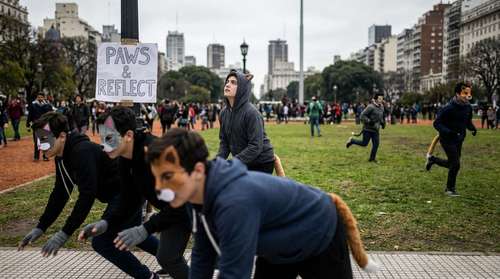
On a sun-drenched Sunday in a bustling Buenos Aires plaza, the usual sights of mate-drinking locals and football-playing children were interrupted by a surreal spectacle. A pack of teenagers, clad in realistic animal masks and faux-fur tails, bounded across the grass on all fours. They weren't filming a movie or performing a play; they were living their truth. This is the world of therians, a rapidly growing Argentina animal subculture where youths identify spiritually or psychologically as non-human animals. As the movement explodes on social media, it is sparking fascination, confusion, and debate across the nation.
The Rise of Buenos Aires Therians
The viral phenomenon recently reached a fever pitch in the Argentine capital, where large groups of adolescents gathered to express their animal identities publicly. Among them was 15-year-old Aguara, a leading figure in the local community who identifies as a Belgian Malinois dog. Calculating her age as two years and two months in canine terms, Aguara led her "pack" through agility drills, leaping over obstacles with surprising athleticism.
"I wake up like a normal person and live my life like a normal person," Aguara explained to local reporters, dispelling myths that therians have lost touch with reality. "I simply have moments when I like being a dog." Her sentiments were echoed by others in the park, including Sofía, who donned a lifelike beagle mask to crawl through the grass, and other participants who climbed trees while dressed as foxes and cats. These gatherings are not just chaotic play; they are organized meetups for a generation finding community in non-human identity.
Therianthropy vs. Roleplay: What's the Difference?
To the uninitiated observer, the line between costume play and therianthropy can seem blurred. However, participants are quick to make distinctions. True therians believe they share an intrinsic, often spiritual connection with a specific animal species. This differs from "furries," who typically create anthropomorphic animal characters, or role-players who act out a part.
The 'Otherpaw' Perspective
The movement is not a monolith. Aru, a 16-year-old attendee wearing a seal mask, described herself as part of the "otherpaw" branch of the subculture. For her group, the masks and "quadrobics"—the athletic practice of moving on four limbs—are more about performance and fun than a deep psychological belief. "It's not necessarily about identifying as an animal," she clarified, noting that Argentina's culture of free expression has allowed these diverse groups to flourish together in public spaces.
A Viral TikTok Trend Explodes
While the gatherings happen in parks, the movement's heartbeat is digital. Viral TikTok trends have propelled the therian community into the mainstream spotlight. The hashtag #therian has surpassed 2 million posts globally, with data showing that Argentina leads all other Latin American countries in engagement. Aguara herself has amassed over 125,000 followers, using her platform to organize meetups and educate the public about their lifestyle.
The algorithmic surge has brought weird world news watchers and curious onlookers to the scene, but it has also attracted critics. Videos of teenagers howling and jumping in public squares often garner mixed reactions, ranging from support for their creativity to bewilderment and hostility from those who view the behavior as disturbing.
Psychological Perspectives on the Phenomenon
As parents and pundits debate the implications of this Argentina animal subculture, mental health experts are weighing in. Débora Pedace, a psychologist and director of the Integral Therapeutic Center in Buenos Aires, suggests that for most participants, this is a form of symbolic identification rather than a clinical delusion.
"From a psychological standpoint, this is a symbolic identification with an animal," Pedace noted in a recent interview. She emphasized that the behavior typically belongs to the realm of adolescent exploration and community seeking. However, she cautioned that it could become problematic if the distinction between human reality and animal persona blurs completely, or if it leads to risky behaviors. For now, though, the majority of Buenos Aires therians appear to be using the subculture as a safe harbor for self-expression in an increasingly complex world.
A Howling Conclusion
Whether viewed as a quirky passing fad or a profound shift in youth identity, the therian movement in Argentina is undeniable. As Aguara and her pack continue to claim space in the city's parks, they challenge societal norms about who—or what—we can be. In a digital age where identity is increasingly fluid, these young Argentines are pausing to paws and reflect, finding their own unique way to run free.