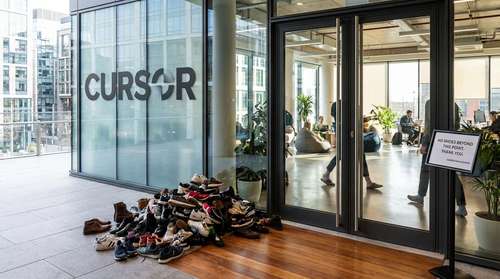
In the high-stakes world of Silicon Valley, where AI unicorns are minted overnight, the latest symbol of status isn't a Tesla Cybertruck or a scarce Nvidia H100 chip—it's a pile of abandoned sneakers. Cursor, the AI-powered code editor valued at a staggering $29.3 billion, has sent the tech world into a frenzy this week after photos circulated of its San Francisco headquarters' entrance, cluttered with dozens of pairs of high-end footwear. The viral images have sparked a heated debate about workplace culture, hygiene, and the eccentric rules of the devastatingly wealthy.
The Photo That Stopped the Scroll
The controversy began circulating heavily on social media platforms like X (formerly Twitter) just 48 hours ago, when a photo surfaced showing the hallway outside Cursor's San Francisco office. Instead of a sleek corporate reception, the image depicted a chaotic jumble of expensive footwear—Hokas, On Clouds, and limited-edition Nikes—heaped outside the door. To the uninitiated, it looked like the aftermath of a chaotic house party; to insiders, it was a clear signal of the company's strictly enforced "no-shoes" policy.
Internet commentators were quick to weigh in, with reactions ranging from amusement to horror. "Imagine raising $2.3 billion and still making your engineers smell each other's socks," one viral comment read. Others defended the practice as a "power move," suggesting that stripping down to socks creates a humble, equalizer effect among staff, regardless of their net worth. The image has since become a meme template for "peak San Francisco" startup culture, illustrating the blurred lines between professional workspaces and domestic comfort.
Inside the 'Zen' of a $29.3 Billion Unicorn
While the internet cracks jokes, Cursor's management insists the policy is about productivity, not pretension. Sources close to the company describe the office atmosphere as "homey" and "zen-like," designed to lower cortisol levels and encourage deep focus—a critical state for engineers building the next generation of AI coding tools. By leaving the grime of San Francisco's streets at the door, the company aims to create a psychological threshold where the chaos of the outside world is swapped for a clean, controlled coding sanctuary.
Cultural Roots and Founder Influence
The policy likely stems from the founders' backgrounds and a growing trend in modern tech offices. Co-founder Arvid Lunnemark hails from Sweden, where removing shoes indoors is standard etiquette. Similarly, the practice aligns with customs in many Asian households, a cultural touchpoint for other leadership members. What was once a quirk of early-stage startups operating out of living rooms has now scaled into a mandate for a decacorn with hundreds of employees, creating logistical hurdles (and tripping hazards) that established corporations rarely face.
The 'Pajama Economy' Meets Hardcore Tech
This "sock-only" mandate signals a broader shift in 2026 workplace norms, often dubbed the "Pajama Economy." As companies mandate return-to-office policies, they are increasingly compromising by allowing—or in this case, enforcing—domestic comforts. However, for a company like Cursor, which recently closed a massive Series D funding round at a near-$30 billion valuation, the rule also serves as a subtle filter. It demands a level of vulnerability and conformity from new hires, signalling that they are joining a "tribe" rather than just a corporation.
Industry analysts note that such eccentricities often become status symbols. Just as the hoodie replaced the suit, the shoeless office may be evolving into the ultimate flex: a sign that a company is so successful and talent-dense that it can rewrite the rules of professional decorum. For the engineers inside, coding in socks is a small price to pay for equity in one of the most valuable private companies in the world.
Silicon Valley's Reaction
The response from the broader tech community has been polarized. Some founders are already copycatting the move, claiming it keeps offices cleaner and reduces noise. Meanwhile, detractors point to the optics of a multi-billion dollar entity requiring visitors to hop around on one foot while unlacing their boots. Regardless of the public opinion, the "Cursor Shoe Pile" has arguably done more for the company's brand awareness this week than any marketing campaign could, cementing its reputation as a place where code comes first—and footwear stays outside.