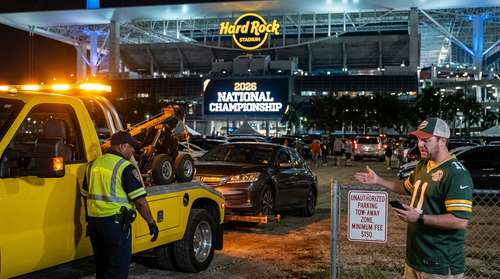
For thousands of fans streaming into Hard Rock Stadium for Monday night's National Championship game between the Indiana Hoosiers and the Miami Hurricanes, the most shocking number wasn't on the scoreboard—it was in the parking lot. As official parking passes on the resale market skyrocketed to an eye-watering $747, a bizarre economic loophole emerged that quickly went viral: it is significantly cheaper to park illegally and get towed than to pay for a legitimate spot. This absurd reality turned the 2026 title game into a chaotic case study of sports pricing gone wrong, with fans opting for the impound lot as a fiscally responsible alternative.
The Economic Absurdity: Parking vs. Towing
The math, while hilarious to social media onlookers, was painfully serious for attendees. By kickoff on January 19, the cheapest available official parking pass on resale sites like StubHub and SeatGeek had ballooned to nearly $750. In contrast, Miami-Dade County's regulated towing fees painted a tempting picture. A standard non-consent tow starts at approximately $153, with a daily storage fee of around $30. Even with an Uber ride to the impound lot the next morning, the total cost of "illegal valet" comes in under $250—saving savvy, rule-breaking fans roughly $500.
"I looked at the parking app and saw $800," said one Indiana fan who parked on a swale three miles from the stadium. "Then I looked up the towing ordinance. It was a no-brainer. I literally saved enough money to buy a celebratory round of drinks after the Hoosiers won. My car is safe in the impound lot; it's basically VIP security for a fraction of the price."
'Tow It': The Meme That Became Reality
Social media platforms like X (formerly Twitter) and TikTok were flooded with videos of fans abandoning their vehicles in no-parking zones, often captioned with the famous Robert De Niro line from Meet the Parents: "Tow it." What started as a joke quickly morphed into a legitimate strategy as desperate fans realized the savings potential. The trend highlights a growing frustration with the exorbitant costs attending major sporting events, where the ticket price is often just the tip of the iceberg.
The Local Hustle
The chaos spilled over into the surrounding neighborhoods of Miami Gardens. While official lots were price-gouging, local residents capitalized on the overflow. Driveway spots were going for $200—a steal compared to the stadium but still a hefty sum. However, for those who arrived late or refused to pay hundreds of dollars to park on grass, the "tow-away zones" became the most attractive real estate in South Florida. Tow truck drivers reported a frenzy of activity, not realizing they were essentially participating in a mass protest against predatory venue pricing.
A Historic Night on the Field and in the Lots
While the parking wars raged outside, history was made inside the stadium. The Indiana Hoosiers completed their fairytale season, defeating the hometown Miami Hurricanes 27-21 to claim their first-ever National Championship. The victory capped an undefeated run for Indiana, adding an extra layer of delirium to the night. For many Hoosier fans, the euphoria of the win made the morning trip to the tow yard feel like a victory lap.
"We won the natty," tweeted one fan from an Uber heading to a Miami towing facility Tuesday morning. "Paying this $160 fine feels like a trophy. Way better than giving the stadium another dime."
The Broken Economics of Modern Sports
This phenomenon at the 2026 National Championship signals a breaking point for fans. When breaking the law becomes a rational financial decision, the pricing models for live events have fundamentally failed. Hard Rock Stadium's parking fiasco joins a growing list of fan exploitations, from $20 beers to four-figure nosebleed seats. While organizers may see the sold-out $747 passes as a sign of demand, the lines of cars waiting to be reclaimed at the impound lot suggest a different story: fans will always find a way, even if it means hitching a ride with a tow truck.