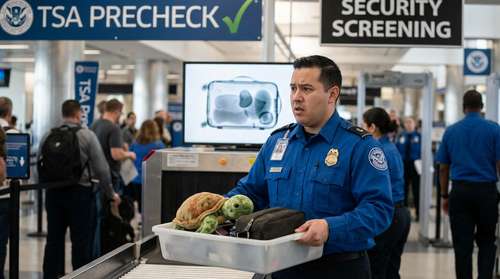
If you thought your travel day was stressful, imagine being the Transportation Security Administration (TSA) officer who had to ask a passenger to remove a live turtle from their underwear. That is exactly the kind of bizarre scenario highlighted in the newly released TSA weirdest finds 2026 list, which details the most baffling items intercepted at U.S. airports over the last year. Released this week, the annual "Top 10 Catches" countdown has officially cemented 2025 as a banner year for bizarre animal smuggling and ill-conceived concealment methods.
Reptiles in Unmentionable Places
While weapons and drugs are standard fare for security interceptions, this year's list took a turn for the zoological. Earning a top spot in the "Hall of Weird" were two separate, unrelated incidents involving travelers hiding hard-shelled reptiles inside their clothing.
In a story that has quickly become the centerpiece of Newark weird news, a man at Newark Liberty International Airport (EWR) was flagged by a body scanner in March. When officers conducted a pat-down of his groin area, the passenger sheepishly produced a live red-eared slider turtle wrapped in a small blue towel, which he had stuffed into the front of his pants. The Newark airport turtle crotch incident wasn't the only case of its kind.
Down south, a similar scenario unfolded at Miami International Airport (MIA) in July. A woman was caught attempting to smuggle two small turtles through a checkpoint by hiding them inside her bra. The Miami TSA bra turtles discovery ended tragically for one of the creatures, which did not survive the ordeal, while the other was turned over to wildlife officials. These funny airport security stories underscore a serious message from the agency: "Please stop hiding animals in weird places on your body."
The "Bomb" That Stopped Boise
While the animal incidents provided comic relief, the number one item on the TSA most unusual items list was far more alarming. At Boise Airport (BOI) in Idaho, a checked bag triggered massive alarms when screening technology detected what appeared to be a fully functional pipe bomb.
The device was constructed from PVC pipe, wires, and wooden blocks, and was even ominously labeled "C4." TSA explosives specialists and local law enforcement were immediately called in, only to discover the item was a realistic replica used for training purposes. While the passenger may have had innocent intentions, the agency emphasized that realistic replicas are strictly prohibited because they cause significant delays and panic. It serves as a stark reminder: if it looks like a bomb, it will be treated like one.
Creative, But Illegal, Concealments
The 2026 reveal also highlighted the lengths to which some travelers will go to hide prohibited items. The creativity on display was matched only by the vigilance of the officers who spotted the contraband.
Hidden in Plain Sight
At Miami International—clearly a hotspot for the unusual this year—officers discovered live ammunition concealed inside a container of Nesquik chocolate powder. Meanwhile, at Anchorage International Airport (ANC), a traveler tried to smuggle pills inside a hollowed-out shampoo bottle, proving that not every liquid container is what it seems.
Dangerous Fashion Statements
Clothing modifications were another popular, albeit failed, strategy. At Denver International Airport (DEN), officers found razor blades meticulously sewn into a passenger's clothing. In a separate incident at Quad Cities International Airport (MLI), a knife was discovered hidden inside a knee brace. Perhaps most brazenly, a traveler at Kona International Airport (KOA) in Hawaii attempted to walk through security with a significant quantity of narcotics concealed inside their bulky shoes.
Why This List Matters
Beyond the entertainment value, the release of these finds serves a practical purpose. It highlights the advanced detection capabilities of modern airport security and acts as a deterrent for future travelers. Smuggling attempts, whether they involve bizarre animal smuggling or fake explosives, can lead to civil penalties of up to $15,000 per violation, missed flights, and potential criminal charges.
As travel volumes return to record highs in 2026, the TSA is urging passengers to use common sense. If you are unsure about an item, use the "What Can I Bring?" tool on the TSA website or ask the agency directly on social media. And for the sake of the animals—and the officers—leave the turtles at home.