It was supposed to be a futuristic bridge across the Atlantic, a digital window connecting the bustling streets of New York City with the historic charm of Dublin. But in a twist that surprises absolutely no one familiar with the internet or human nature, the Dublin NYC Portal has been unceremoniously powered down. What began as a high-minded art installation celebrating global unity quickly devolved into a chaotic spectacle of flashing, offensive imagery, and drunk antics, proving once again that we simply cannot have nice things.
The High-Tech Experiment That Went Wrong
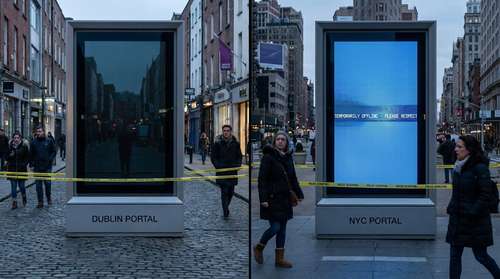
The transatlantic art installation, known simply as "The Portal," launched with grand ambitions. Created by Lithuanian artist Benediktas Gylys, the massive circular screens—one next to the Flatiron Building in Manhattan and the other on O'Connell Street in Dublin—offered a 24/7, silent, real-time video link between the two cities. The goal was to transcend borders and foster a sense of shared humanity.
For the first few hours, it worked. Tourists waved, friends reunited digitally, and strangers played bouts of rock-paper-scissors across the ocean. But the wholesome vibes didn't last. As the New York Dublin webcam feed gained traction on social media, it attracted a different kind of crowd. The viral internet culture machine kicked into high gear, and the installation transformed from a beacon of connection into a stage for performative absurdity.
Flashes, 9/11 Jokes, and Drunken Antics
The Portal livestream shutdown wasn't triggered by a technical glitch, but by a rapid accumulation of "inappropriate behavior." Social media platforms like TikTok and X (formerly Twitter) were flooded with clips of the chaos. On the Dublin side, onlookers were filmed holding up photos of the Twin Towers burning on 9/11 to taunt New Yorkers—a grim "joke" that instantly went viral.
Not to be outdone, the New York side saw its own share of indecency. An OnlyFans model, Ava Louise, claimed responsibility for flashing her breasts at the portal, an act that sent shockwaves through the live feed and social media. Meanwhile, reports surfaced of people mooning the camera, grinding against the screen, and pretending to snort drugs in full view of the families walking by in the other city. The weird world news cycle exploded, turning the art piece into a reality TV show of the worst kind.
The Breaking Point
The situation reached a fever pitch when police in Ireland had to intervene, escorting a woman away who was seen "slapping and grinding" against the structure. The accumulation of these incidents left officials with no choice. The feed, which was meant to run 24/7, was cut. Screens went dark, leaving bewildered tourists staring at a blank void where their transatlantic counterparts used to be.
Officials Pull the Plug: 'Technical Solutions' Needed
Following the wave of funny viral news—and the not-so-funny harassment—organizers announced a temporary suspension of the link. The Dublin City Council and the Flatiron NoMad Partnership released statements citing the need for "technical solutions" to curb the inappropriate behavior. While the vast majority of interactions were positive, the minority of disruptors managed to ruin the experience for everyone.
Proposed solutions include implementing blurring technology that triggers if people get too close or if the camera detects nudity, as well as installing physical barriers to keep the public at a distance. The shutdown highlights the immense challenge of placing uncensored, real-time technology in public spaces without accounting for the trolls who inevitably show up.
Why We Can't Look Away
The Dublin-NYC Portal saga is a perfect case study in modern viral internet culture. It demonstrated how quickly a well-intentioned public space can be co-opted for clout. In the age of social media, the Portal wasn't just a window to another city; it was a stage for content creation. The flashing, the offensive memes, and the mockery were all performed not just for the people on the other side, but for the millions watching online.
As the portal remains dark, waiting for its "software updates" and new guardrails, the world is left to ponder the limits of digital connection. The experiment succeeded in connecting us, but perhaps it revealed a little too much about who we are when given an open mic—or in this case, an open camera—to the world.