
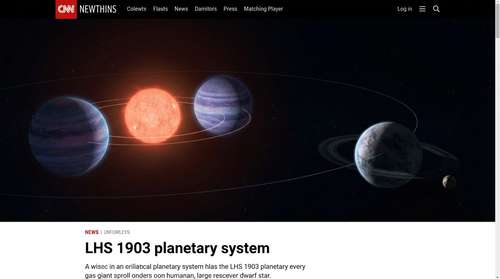
Astronomers have just uncovered the galaxy’s newest freak show, and it’s effectively rewriting the rulebook on how solar systems are built. In a bizarre space discovery announced this week, scientists identified a unique inside-out planetary system orbiting the red dwarf star LHS 1903. Unlike our own solar system—where rocky worlds hug the sun and gas giants dominate the outer reaches—this weird world news features a small, rocky planet orbiting in the deep, cold void far beyond its massive gaseous siblings. This unprecedented arrangement has left researchers baffled, as it seemingly defies the laws of physics and standard exoplanet formation theories.
The "Impossible" Architecture of LHS 1903
Located approximately 116 light-years from Earth, LHS 1903 (also known as TOI-1730) initially looked like a standard planetary system. Early observations revealed a rocky inner world followed by two massive gas giants—a pattern consistent with the architecture of our own solar system. However, a closer look using the European Space Agency’s CHEOPS satellite shocked the astronomical community.
Lurking at the outer edge of the system is a fourth planet, LHS 1903 e, which is not the expected gas giant, but a small, dense rocky world similar to Venus. This discovery creates a chaotic "rocky-gaseous-gaseous-rocky" sequence that has never been seen before. According to Thomas Wilson, the study’s lead author from the University of Warwick, this finding marks the first time such an arrangement has been confirmed, challenging the very foundation of astronomy news 2026.
Why This System Shouldn't Exist
For centuries, the standard model of planetary formation has been clear: rocky planets form close to their host stars where intense radiation strips away light gases, while gas giants form in the colder outer regions where hydrogen and helium can accumulate into thick atmospheres. LHS 1903 throws a wrench into this machinery.
Finding a rocky planet in the frozen outer zone is like finding a snowman in the middle of the Sahara. Theoretically, a planet forming that far out should have accreted enough gas to become a Jupiter-sized giant. The fact that LHS 1903 e remains a small, naked rock suggests it formed in an environment completely depleted of gas—a scenario that was previously considered impossible for such a young system.
The "Inside-Out" Formation Theory
To explain this bizarre space discovery, scientists are proposing a radical new theory: sequential "inside-out" formation. Instead of all planets forming simultaneously from a single protoplanetary disk, the worlds of LHS 1903 may have formed one by one, like a cosmic assembly line.
In this scenario, the inner planets formed first, sweeping up the available gas and dust. By the time the outer seed for LHS 1903 e began to coalesce, the system’s gas reserves were likely exhausted. The result is a planetary runt—a rocky core that never got the chance to wrap itself in a gaseous blanket. This evidence of gas-depleted formation provides a crucial missing link in our understanding of impossible planets.
Rethinking Alien Worlds
The discovery of LHS 1903 is a wake-up call for exoplanet hunters. It proves that our solar system is not the blueprint for the cosmos but merely one variation in a vast spectrum of possibilities. As telescopes like James Webb and CHEOPS continue to peer into the darkness, we are finding that the universe is far stranger than our models predicted.
"This strange disorder makes it a unique inside-out system," Wilson noted, emphasizing that nature often finds ways to exist in the margins of our understanding. As we move further into 2026, the LHS 1903 system stands as a reminder that when it comes to the galaxy, the only rule is to expect the unexpected.