In what might be the peak of productive laziness for 2026, a software engineer has gone viral for building a complex AI system with a singular, incredibly specific purpose: regulating his ceiling fan speed so he doesn't have to wake up. Dubbed the "ultimate bachelor hack" by social media users, this AI roommate uses computer vision to watch its creator sleep, adjusting the room's airflow based on whether he looks hot or cold. It is a hilarious yet brilliant example of how techie builds AI fan controllers are outpacing expensive smart home gadgets.
The '3 AM Problem' That Sparked a Viral Invention
We have all been there: It is 3:00 AM, and you wake up either shivering under a sheet or sweating through your pajamas. For Pankaj, a Bengaluru-based software engineer known as @the2ndfloorguy on X (formerly Twitter), this nightly struggle became the mother of invention. He was tired of the "3 AM dance"—waking up to groggily fumble for a remote or pull cord because the temperature had shifted.
Instead of buying a standard smart fan or just keeping an extra blanket nearby, Pankaj did what any self-respecting engineer would do: he over-engineered a solution. He decided to build a custom AI roommate that would stay awake all night, monitoring his comfort levels so he wouldn't have to.
How the Ceiling Fan AI Control Actually Works
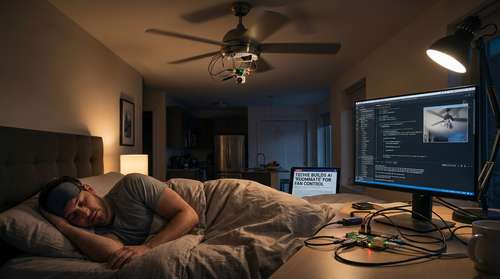
While early rumors suggested the system used complex body temperature sensors, the reality is even more ingenious—and slightly creepier. The system runs on a Raspberry Pi home server equipped with a camera that points directly at the bed. Using a machine learning model called MediaPipe for pose detection, the AI analyzes Pankaj's sleeping position in real-time.
The logic is delightfully simple human behavior translated into code:
- Fan ON: If the AI sees arms or legs sticking out from under the blanket, it infers the user is hot.
- Fan OFF: If the user is curled up in a ball or fully tucked in, the system infers they are cold.
Once the "AI roommate" decides a change is needed, it sends a signal to a custom-built, robotic "button pusher" mounted on the wall. This mechanical finger physically presses the fan's control switch, closing the loop on a completely automated climate control system.
Productive Laziness: The New Smart Home Trend
This project fits perfectly into the rising trend of funny tech inventions 2026, where high-level engineering is applied to low-stakes domestic annoyances. Social media users have praised the project as a masterpiece of "productive laziness"—the art of spending dozens of hours coding and soldering to save yourself three seconds of effort later.
"Your AI roommate does more for you than most actual roommates," one user quipped on the viral thread. Another noted the irony of building a surveillance system just to avoid using a remote, calling it "overkill in the best possible way."
Why DIY Beats Big Tech
What makes this smart home viral news story stand out is that it solves a problem big tech companies haven't. Most smart thermostats measure the temperature of the room, not the person. By using visual cues, Pankaj's system reacts to how the user actually feels, creating a personalized micro-climate that standard automated systems can't match.
Weird AI Stories and the Future of Sleep Tech
This isn't the only oddity emerging in the world of home automation this week. As 2026 unfolds, we are seeing a surge in weird AI stories where hobbyists are taking control of their devices in unexpected ways. From AI that judges your refrigerator contents to mirrors that compliment your outfit, the "DIY AI" movement is democratizing smart home tech.
However, the ceiling fan AI control remains the current champion of the internet. It reminds us that technology doesn't always have to be about saving the world or maximizing productivity. Sometimes, it's just about ensuring you never have to kick the covers off in the middle of the night again.