
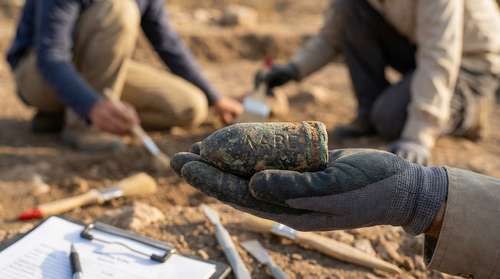
If you think internet trolls invented sarcastic clapbacks, a recent archaeological discovery in 2026 is about to prove you wrong. Researchers excavating the ancient city of Hippos in Israel have unearthed an ancient sarcastic bullet with a darkly humorous message aimed right at enemy forces. The tiny, almond-shaped projectile is a 2100 year old lead bullet inscribed with the Greek letters "ΜΑΘΟΥ" (mathou), which translates directly to "Learn" or "Learn your lesson". Found in the ruins of a military siege, this fascinating artifact reveals that ancient psychological warfare often involved a healthy dose of taunting, proving human nature hasn't changed much over the millennia.
A First-of-Its-Kind Discovery
The artifact was discovered in the Golan Heights along the eastern shore of the Sea of Galilee, an area that has become a treasure trove for Hippos Israel archaeology. Led by archaeologists Dr. Michael Eisenberg and Arleta Kowalewska from the University of Haifa, the excavation team stumbled upon the rare projectile while scanning a necropolis near the Sussita Stream.
While the team has uncovered 69 different lead sling projectiles at the site over the years, this one stands alone. It represents the first time the word "Learn" has ever been found on a piece of ancient ammunition anywhere in the world. According to Eisenberg, the inscription was a deliberate taunt from the city's defenders. It was meant to mock their attackers, effectively saying, "Next time, you should learn not to come here". This early form of ancient Greek trolling highlights how soldiers injected dark humor into life-or-death situations.
The Brutal Reality of Ancient Psychological Warfare
To understand why someone would carve a sarcastic remark into a weapon, you have to look at the mechanics of ancient siege combat. Before firearms, lead sling bullets were the mass-produced artillery of the Hellenistic world. They were cheap to manufacture using simple stone molds and incredibly deadly.
A skilled slinger using a leather pouch could launch a light lead bullet at staggering speeds, hitting targets from up to 1,300 feet (400 meters) away. The newly discovered projectile measures just 1.3 inches long and currently weighs about 38 grams. However, researchers note that one side is heavily deformed from a massive impact. They estimate it originally weighed around 45 grams before it smashed into its target—whether that was a siege engine, a rock, or an unlucky human.
Inscribing these deadly projectiles was a known, albeit rare, practice used to intimidate or curse the enemy. Common adornments discovered by researchers include:
- Divine Symbols: Imagery like the lightning bolt of Zeus or the trident of Poseidon, meant to imbue the ammunition with god-like destructive power.
- Military Flexes: The names of specific commanders or cities, stamped into the metal to assert dominance and authority.
- Grim Jokes: Earlier excavations across the region have uncovered bullets bearing taunts like "Catch!" or "Take a taste".
The Hippos discovery is uniquely significant because it is the first time the specific command to "Learn" has been recorded on ancient ammunition.
The Siege of Hippos: Who Fired the Projectile?
The context of this weird history news adds even more color to the story. Hippos, originally founded as a Greek polis in the second century BCE, frequently found itself in the crosshairs of territorial disputes. The research team believes this specific bullet was likely fired during a major conflict around 101 BCE.
At that time, the Hasmonean army of King Alexander Jannaeus was actively expanding his kingdom, advancing toward the Galilee and Golan regions. To reach the fortified city of Hippos, the besieging forces would have had to march up a steep, exposed road along the Sussita Stream. The Greek-speaking defenders, positioned high above on the city walls, had a massive tactical advantage. They launched showers of lead upon the approaching troops.
Finding the bullet at the bottom of this topographic saddle perfectly matches the predicted trajectory of a projectile fired downward from the city's defenses. The fact that the bullet bears a massive impact scar confirms that the defender's shot connected with something in the valley below.
Unearthing History Through Modern Methods
The details of this remarkable find were published recently in the peer-reviewed journal Palestine Exploration Quarterly. The University of Haifa team utilized advanced metal detectors to locate the lead artifact near the ancient roadbed, demonstrating how modern surveying techniques continue to shed light on forgotten battle tactics.
While the inscription is brief, it bridges a massive temporal gap between modern society and the Hellenistic period. Behind every artifact is a human being, and this relic provides an incredibly relatable glimpse into the mindset of a soldier defending his home. The snarky "Learn your lesson" carved into the metal reminds us that sarcasm has always been a universal language—especially on the battlefield.