
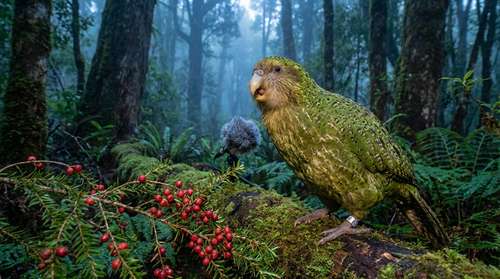
If you’re wandering through the dense forests of New Zealand’s remote predator-free islands this week, you might hear a sound that resembles a rusty mattress being aggressively jumped on. That isn’t a sign of confused campers—it’s the chaotic, high-decibel romance of the kakapo, the world’s heaviest and strangest parrot. Following a massive "bumper berry" harvest reported just yesterday, these critically endangered birds have officially entered a rare, booming mating frenzy that experts are calling the loudest and most promising event in years.
The ‘Rusty Bedspring’ Serenade
As of February 24, 2026, conservationists confirm that the kakapo population is in the throes of a record-breaking breeding season. The male kakapo, a flightless, nocturnal bird that looks like an owl and walks like a duck, has a unique way of wooing mates. He digs a shallow bowl in the earth to act as a sound amplifier and emits a deep, sonic "boom" that can be heard for miles. But it’s the accompanying metallic "ching" sound—uncannily similar to squeaky, rusty bedsprings—that is currently filling the night air on Whenua Hou (Codfish Island).
"The forest is absolutely alive with noise right now," says a field ranger stationed on Pukenui Island. "It sounds like an industrial workshop out here. The males are booming and chinging all night long because the competition is fierce." This acoustic phenomenon is known as "lek breeding," a behavior unique among parrots, where males gather to compete for female attention solely through the power of their weird vocal performance.
Fruit Overload: The Rimu Berry Trigger
Why now? The sudden explosion of romance is directly tied to a botanical event known as a "mast year." The native rimu trees have produced a staggering "bumper crop" of nutrient-rich berries this summer, an event that only happens every two to four years. Recent surveys indicate that over 60% of rimu branch tips are laden with fruit, a feast that acts as a biological green light for the kakapo to breed.
Without this specific fruit, the birds simply aren't interested. The berries provide the high levels of Vitamin D and calcium required for females to lay healthy eggs and raise chicks. This year's harvest is so abundant that experts believe it could support a record number of hatchlings, potentially surpassing the population boom of 2022. "They are stuffing themselves with berries and getting into prime condition," noted a Department of Conservation representative.
Breaking Records: Yasmine and the New Chicks
The excitement isn't just about the noise; it's about results. Just days ago, on Valentine's Day, a chick named Yasmine hatched, marking the first success of this frantic season. As of late February 2026, the total kakapo population stands at approximately 237 birds. Every single new chick is vital for the survival of the species, which was once decimated to just 51 individuals in the 1990s.
A High-Tech Love Story
Managing this strange bird romance involves more than just listening to booms. The kakapo recovery effort is one of the most tech-heavy conservation projects on Earth. Each bird is equipped with a smart transmitter that tracks its location, activity, and even who it mates with. Rangers are currently using drones and remote sensors to monitor nests without disturbing the protective mothers.
This week, livestreamed footage from underground nests has captivated global audiences, showing the clumsy but endearing birds caring for their precious eggs. It’s a reality show where the stakes are the literal survival of a species. With the mating season peaking right now, conservationists are cautiously optimistic that the "rusty bedspring" symphony will result in a baby boom that secures the kakapo's future for another generation.