Springtime brings a host of familiar traditions, but this year, one Michigan business gave a classic holiday treat a rather unsettling makeover. The internet has found its newest obsession, and it comes in the form of a Detroit viral lamb cake that looks less like a sweet pastry and more like a creature lurking in the shadows of a haunted house. What started as an innocent holiday joke has rapidly transformed into a masterclass in unintentional marketing, proving that a nightmare Easter dessert might just be the secret ingredient to massive online success.
A Prank Gone Wild at Homestead Kitchen
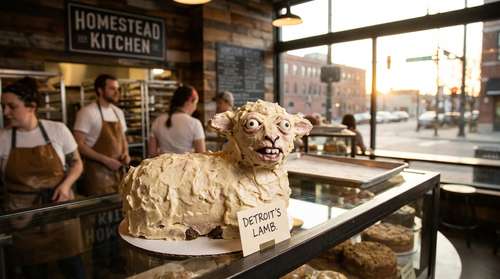
The chaos kicked off on April 1, 2026, when Homestead Kitchen Artisan Cakery decided to participate in the annual tradition of internet hoaxes. Instead of posting a subtle prank, the local bakery went straight for the shock factor, uploading an image of a lamb-shaped pastry that immediately traumatized their social media followers. Featuring bulging, unblinking eyes, an uneven set of crooked teeth, and droopy, melting frosting, the cursed lamb cake looked like it belonged in a horror film rather than at the center of a Sunday dinner table.
To make the gag even more convincing, the shop casually instructed customers to place their holiday orders, listing completely normal flavors like lemon and chocolate. The visual dissonance of a demonic-looking creature paired with a cheerful sales pitch sent the post into the stratosphere of virality.
Why the Cursed Lamb Cake Broke the Internet
Social media algorithms thrive on the bizarre, and this pastry delivered on all fronts. Almost immediately after the image dropped, comment sections across platforms ignited with a mix of genuine horror and uncontrollable laughter. Users flooded feeds with memes, turning the terrifying treat into a prime piece of trending LOL news.
Some commentators likened the unsettling confection to literal roadkill, while others joked it resembled an elementary school papier-mâché project that had gone severely wrong. People playfully tagged their friends, demanding they bring the monstrosity to their upcoming family gatherings. Because traditional holiday treats are usually flawless and picturesque, the jarring appearance of this creature tapped directly into the internet's love for funny Easter cake fails. One user even quipped that they needed a knife just to put the dessert out of its misery.
The Tradition Behind the Trend
Before it became the subject of digital mockery, the lamb-shaped cake held a long-standing position as a cherished springtime tradition, particularly in Polish, German, and Italian households. For decades, families have carefully poured batter into specialized cast-iron molds to create sweet, powdered-sugar-dusted centerpieces meant to symbolize rebirth and the start of spring.
But anyone who has ever attempted to bake one knows that these specialized molds are notoriously difficult to master. A slight miscalculation in baking time or a rush to remove the cake from its casing often results in decapitated heads, missing ears, or structural collapses. This inherent difficulty is exactly why the web was so quick to believe the Detroit bakery's post. We have all seen our fair share of kitchen disasters, making the jump from a standard baking mishap to a full-blown monster seem entirely plausible.
From Outrage to Inspiration: The Bakery's Brilliant Pivot
However, not everyone realized they were looking at a digitally conjured gag. Because the image was actually an AI-generated rendering meant purely for laughs, the bakery soon found itself fielding messages from genuinely concerned patrons. Some followers were outraged, questioning the shop's quality standards and calling the design horrifying.
Sensing that the joke had taken on a life of its own, the team quickly stepped in to clear the air. By April 2, they issued a statement assuring their community that the terrifying image was not reflective of their actual culinary skills or standard menu offerings. They confirmed it was merely a holiday hoax.
But the internet had already spoken, and the demand for the bizarre was too loud to ignore. Recognizing the massive engagement they had generated among fans of viral bakery pranks 2026, the shop made a highly strategic business move. Instead of simply apologizing and retreating to their traditional, aesthetically pleasing designs, the bakery announced plans to actually bake real, intentionally creepy lamb cakes for customers who wanted to keep the joke going.
The Legacy of a Horror Dessert
There is a fascinating psychological phenomenon behind why we love ugly things, and this incident captures it perfectly. In an era where every brand strives for curated perfection, a wildly imperfect, chaotic pastry stands out. By leaning into the absurdity of the situation, the shop successfully turned a brief moment of online confusion into a highly profitable, real-world campaign.
The saga of the horrifying pastry highlights exactly what it takes to capture the public's attention today. You do not always need a massive advertising budget or a flawless aesthetic to make waves. Sometimes, all it takes is a willingness to embrace the weirdness of your audience and serve up something entirely unexpected. As families gather around their beautifully decorated tables this season, many will undoubtedly be wishing their centerpiece was just a little more terrifying.
Ultimately, the Detroit viral lamb cake has cemented its place in the pantheon of legendary internet food moments. It proves that a great sense of humor can forge a stronger connection with a community than a pristine storefront ever could. Whether you prefer your holiday sweets to look like beautiful centerpieces or sleep paralysis demons, Homestead Kitchen Artisan Cakery has ensured this is one spring weekend the internet will never forget.