
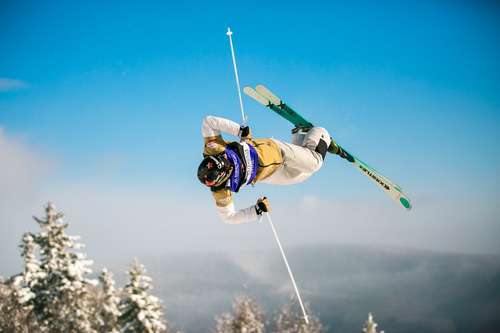
Just when you thought the 2026 Winter Olympics couldn't get any stranger, the ski jumping world has delivered a controversy that frankly defies satire. Dubbed 'Penisgate' by the international press, a bizarre new scandal has rocked the Milano Cortina Games, forcing the World Anti-Doping Agency (WADA) to launch a formal inquiry into allegations that male athletes are using genital injections to game the system. Yes, you read that correctly: rival nations are accusing competitors of artificially enhancing their anatomy—specifically their penile girth—to exploit loop-holes in suit regulations and gain an aerodynamic advantage.
The 'Sail Effect': Why Size Matters in Ski Jumping
To understand why an athlete would endure the agony of a penile injection for a gold medal, you have to understand the physics of ski jumping. In this sport, the athlete's body and suit act as a wing. The more surface area you can generate, the more lift you get, and the farther you fly. To keep things fair, the International Ski Federation (FIS) strictly regulates suit sizes based on an athlete's actual body measurements. A suit can only be a specific amount larger than the body inside it.
Here is where the alleged cheating mechanism comes into play. Reports originally surfacing from the German newspaper Bild suggest that some jumpers are using hyaluronic acid fillers or other substances to temporarily increase their crotch measurements during official fittings. By artificially inflating these measurements, they are permitted to wear a slightly baggier suit. Once in the air, that extra fabric acts like a sail, catching the wind and potentially adding meters to their jump distance.
The Science Behind the Scandal
It sounds ridiculous, but the math checks out. According to research cited in the scientific journal Frontiers, even minute changes in suit aerodynamics can have massive consequences. Experts estimate that a mere 2-centimeter increase in suit circumference can reduce drag by roughly 4% and increase lift by 5%. In competition terms, this 'crotch advantage' could translate to an extra 5.8 meters of flight distance—an eternity in a sport often decided by centimeters.
WADA Steps In: 'We Will Look At Anything'
The rumors have become so loud that they reached the highest levels of Olympic governance. During a press conference in Milan earlier this week, WADA officials were forced to address the issue head-on. While WADA President Witold Bańka initially cracked a smile regarding the uncomfortable subject, the agency's stance is serious.
"I'm not aware of the details of ski jumping and how this can improve performance, but if anything was to come to the surface, we would look at anything if it is actually doping related," stated WADA Director General Olivier Niggli. While hyaluronic acid itself isn't a banned performance-enhancing drug in the traditional sense, using medical procedures to manipulate equipment checks falls squarely under the umbrella of "method doping" and tampering.
Governing Body Calls it a 'Wild Rumor'
Not everyone is convinced that athletes are resorting to such extreme measures. The International Ski Federation (FIS) has moved quickly to shut down the speculation, dismissing the reports as "wild rumors" without evidence. FIS spokesman Bruno Sassi told reporters, "There has never been any indication, let alone evidence, that any competitor has ever made use of a hyaluronic acid injection to attempt to gain a competitive advantage."
However, skepticism remains high because ski jumping has a rich history of creative cheating. Just last year, the sport was embroiled in a different suit manipulation scandal involving the Norwegian team, where coaches were banned for secretly altering suit seams to increase surface area. In a sport where athletes starve themselves to be lighter and spend thousands on wind-tunnel testing, the lengths competitors will go to for gold are often limitless.
A New Frontier in Cheating?
Whether 'Penisgate' turns out to be a verified conspiracy or just an urban legend fueled by pre-Olympic tension, it highlights the extreme pressure of the 2026 Games. As the events kick off in Predazzo, officials are now reportedly conducting more rigorous body scans and suit checks to ensure fair play. For now, the world watches with bated breath—and perhaps a bit of confusion—wondering if the deciding factor in this year's ski jump will legitimately be who has the most 'guts', or simply who has the most... filler.