In a bizarre clash between human digestion and digital creativity, a university student in the United States has been detained after literally consuming a classmate's award-winning AI-generated artwork. The incident, which occurred at the University of Alaska Fairbanks (UAF), has sparked a viral debate on social media about the value of artificial intelligence in the art world. Dubbed the 'snack-tivist' by amused onlookers, the student's performance art protest against machine-generated creativity has left the campus buzzing and the digital art community divided. This latest weird news 2026 story highlights the growing tension between traditional artists and the rising tide of AI vs human creativity.
The 'Art Hunger' Incident: A Digestible Protest
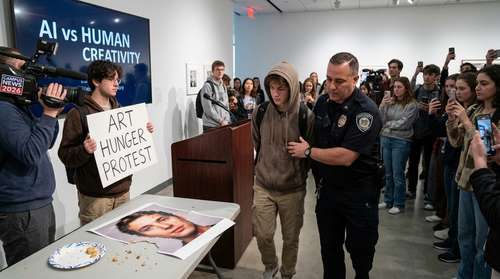
The controversy unfolded earlier this week at the UAF Fine Arts Gallery during the "This Is Not Awful" student exhibition. Witnesses report that film and performing arts major Graham Granger approached the exhibit "Shadow Searching: ChatGPT Psychosis," a collection of 160 Polaroid-style images created by MFA student Nick Dwyer using generative AI tools. Instead of critiquing the composition or lighting, Granger proceeded to rip the prints off the wall and vigorously chew them.
Campus security arrived to find Granger midway through his "meal," having reportedly destroyed or consumed approximately 57 of the displayed images. "He was tearing them up and shoving them in his mouth like it was a hot-dog eating contest," said Ali Martinez, a fellow student who witnessed the event. "He claimed it was a necessary human response—returning the soulless machine art back to the organic cycle." The act, which Granger later described as "performance art," was intended to challenge the university's policy on allowing AI-generated submissions in academic galleries.
Legal Consequences for the Snack-tivist
Granger was taken into custody by campus police and subsequently charged with criminal mischief in the fifth degree. Interestingly, the charge reflects the unique legal status of the damaged property; because the images were AI-generated, they currently hold no copyright value under US law, keeping the estimated damages under $250. This legal technicality has added another layer of irony to the AI art protest, fueling discussions on legal forums and social media platforms like Reddit's r/aiwars.
Artist's Reaction: Vulnerability and Validation
Nick Dwyer, the creator of the consumed installation, was left stunned but philosophical about the destruction of his work. His piece was meant to explore "AI psychosis" and the blurring lines of identity in the digital age. In a statement to the student newspaper The Sun Star, Dwyer remarked, "When you make art, you become vulnerable, and so the artwork is vulnerable. That's something that makes it seem more alive or more real." Some critics have pointed out the irony that Granger's act of destruction may have imbued the digital art controversy with more human emotion than the original algorithmic images possessed.
Viral Campus News: The Internet Reacts
As footage of the "Art Hunger" protest spread online, the story became an instant piece of viral campus news. Social media users have been quick to pick sides, with hashtags like #ArtHunger and #Snacktivist trending on X (formerly Twitter) and Bluesky. Traditional artists have hailed Granger as a folk hero fighting against the "slop" of generative AI, while AI proponents argue that destroying another student's work—regardless of its origin—is an act of censorship and vandalism.
"It's the ultimate critique," wrote one user on the funnyvot.com forums. "If AI art is just 'content' to be consumed, this guy just took it literally." The incident draws parallels to Maurizio Cattelan's famous "Comedian" (the taped banana), which was also eaten by a performance artist, suggesting that in the bizarre art world of 2026, consumption is the sincerest form of criticism.
The Future of AI vs Human Creativity
This strange event serves as a microcosm for the broader cultural anxiety surrounding AI vs human creativity. As universities struggle to update academic integrity policies to keep pace with technology, students are finding their own, sometimes radical, ways to voice their displeasure. The UAF administration has yet to release a formal statement regarding future policies on AI art exhibits, but the "Art Hunger" incident ensures the conversation will continue—perhaps with fewer appetizers involved.
For now, Granger awaits his next court appearance, having successfully transformed a quiet gallery exhibition into a global headline. Whether viewed as a criminal act or a brilliant piece of performance art, one thing is certain: in the battle over the soul of art, things are getting messy.