
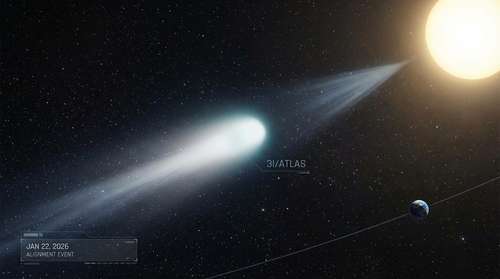
January 22, 2026 – Today marks a pivotal moment in modern astronomy as the enigmatic interstellar visitor 3I/ATLAS reaches a rare and precise alignment with Earth and the Sun. Astronomers worldwide are training their instruments on the constellation Cancer, where this cosmic traveler is currently defying standard cometary physics. Unlike typical comets that streak through our neighborhood with tails blown dutifully away from the Sun by solar wind, 3I/ATLAS is displaying a baffling "anti-tail"—a massive dust trail and jet structure pointing directly toward the star it is supposed to be fleeing. This event, being called the "Full Moon phase" of the comet due to its perfect illumination, offers a fleeting window to solve the mystery of our third confirmed interstellar guest.
A Perfect Cosmic Alignment: The 3I/ATLAS Opposition Surge
At exactly 13:00 UTC today, Earth passes directly between the Sun and 3I/ATLAS, creating a geometric phenomenon known as an astronomical opposition surge. According to data from the Jet Propulsion Laboratory (JPL), the misalignment angle is a razor-thin 0.69 degrees. This precise geometry means the comet is fully illuminated from our perspective, potentially triggering a dramatic spike in brightness.
While 3I/ATLAS alignment events are predictable, the visual results are not. "We are seeing a brightness surge that could help us determine the composition of this alien surface," notes a report from the Harvard-Smithsonian Center for Astrophysics. Currently sitting at a visual magnitude of approximately 16.7, the object requires powerful telescopes to observe, but the data flooding in today is expected to rewrite our understanding of interstellar object 2026 dynamics.
The 'Anti-Tail' Mystery: Why is it Pointing the Wrong Way?
The most striking feature of today's observation is the comet's "wrong-way" tail. In standard cometary science, solar radiation pressure and solar wind push gas and dust away from the Sun, creating a tail that trails the comet or points outward. However, interstellar visitor 3I/ATLAS is exhibiting a "sunward jet"—a tightly collimated stream of material firing directly toward the Sun.
This comet anti-tail mystery has sparked intense debate. While geometric illusions can sometimes create the appearance of a sunward spike (a phenomenon seen in Comet Arend-Roland in 1957), the 3I/ATLAS structure appears to be a physical jet rather than a trick of perspective. Recent Hubble Space Telescope images analyzed by astronomers suggest the presence of three distinct "mini-jets" actively spewing material, hinting at a complex, rotating nucleus that survives despite the intense solar heat.
The 'Rule-Breaker': How 3I/ATLAS Defies Expectations
Discovered on July 1, 2025, by the Asteroid Terrestrial-impact Last Alert System (ATLAS) in Chile, this object was quickly identified as interstellar due to its hyperbolic trajectory. Unlike its predecessors—the cigar-shaped 'Oumuamua (1I) and the rogue comet Borisov (2I)—3I/ATLAS is a different beast entirely. It originated from the southern celestial hemisphere, a direction opposite to the solar apex, surprising researchers who expected visitors from the "front" of our solar system's movement through the galaxy.
Classified under weird science news, the object's behavior has only gotten stranger since its perihelion (closest approach to the Sun) in October 2025. Instead of breaking apart or fading, it has developed a complex coma rich in cyanide, water, and organics, yet it lacks the massive chaotic outgassing of a typical solar system comet. This stability, combined with its anomalous sunward jets, has led some leading theoretical physicists to speculate on "artificial" or non-natural explanations, though the consensus remains that we are looking at an exotic, natural icy body from a nitrogen-rich exoplanetary disk.
Viewing the Anomalies Today
For amateur astronomers with large-aperture telescopes (10-inch or larger) and CCD cameras, 3I/ATLAS is technically visible in the constellation Cancer. However, the real show is in the data being collected by space-based assets. NASA's TESS (Transiting Exoplanet Survey Satellite) has interrupted its standard sector scan to stare at the comet for this entire week, capturing continuous light curves that will reveal how fast the object is rotating.
Preliminary light curve data suggests the object is tumbling, with a rotation period of approximately 7.2 hours. This wobbling motion, combined with the space anomalies today, creates a "lighthouse effect" where the anti-tail sweeps across the field of view. Researchers hope that today's high-contrast opposition images will reveal if the "mini-jets" are symmetrical—a feature that would be incredibly difficult to explain with standard geological evaporation models.
A Farewell to Our Interstellar Guest
Following today's peak alignment, 3I/ATLAS will continue its journey back into the deep void. Traveling at excess hyperbolic speeds, it will never return to our solar system. The data harvested during this brief window of astronomical opposition surge will likely be analyzed for decades. Is it a shard of a Pluto-like planet from another star? A dark hydrogen iceberg? or something else entirely?
As the "Interstellar Rule-Breaker" fades into the dark, it leaves us with more questions than answers, reminding us that our galaxy is teeming with objects that refuse to follow our local laws of physics.